Diode laser pump sources for high-energy lasers in fusion power plants
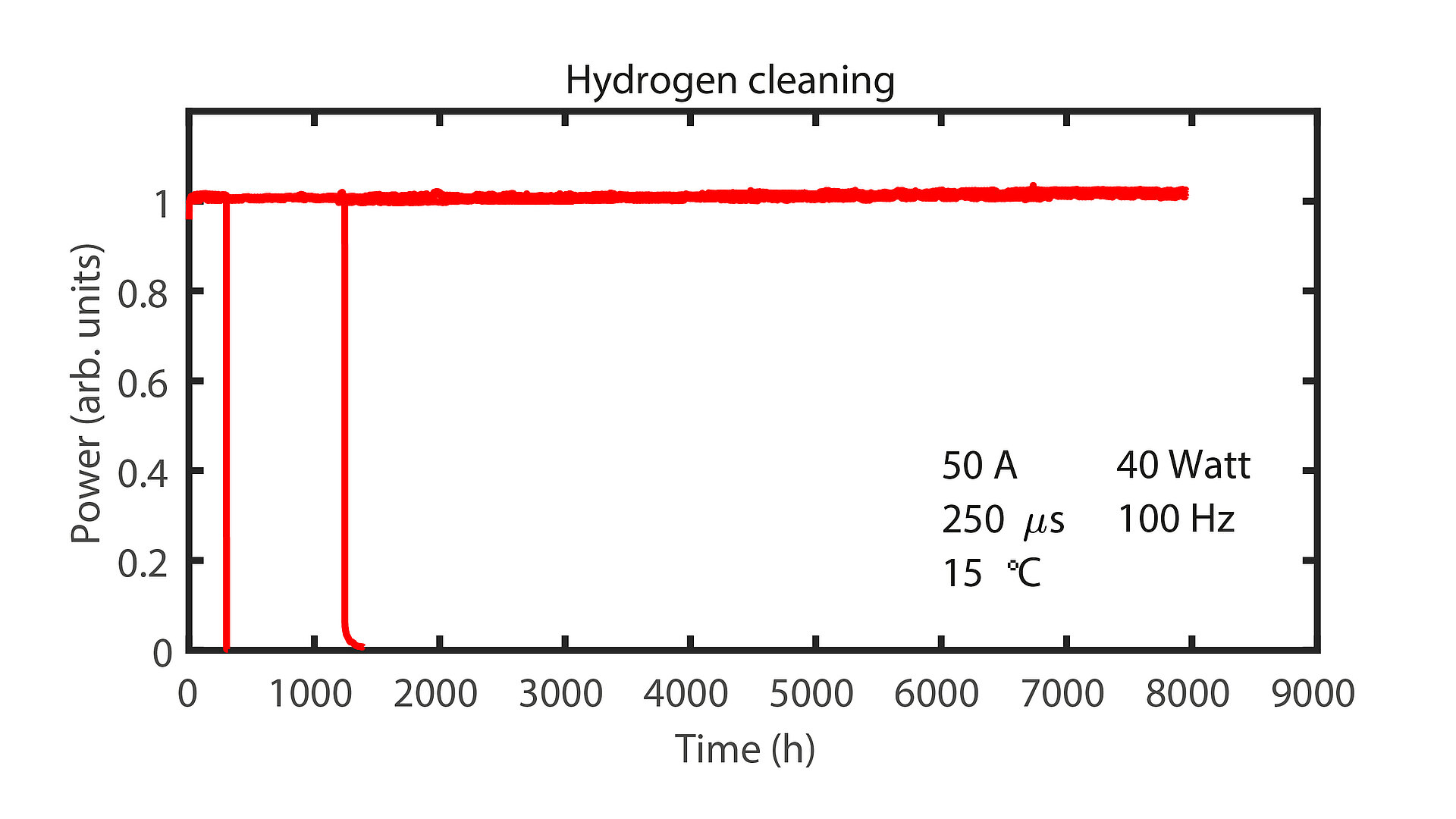
Fig. 1: QCW aging of five 88x nm broad area single emitters with 200 µm stripe width using the indicated parameters.
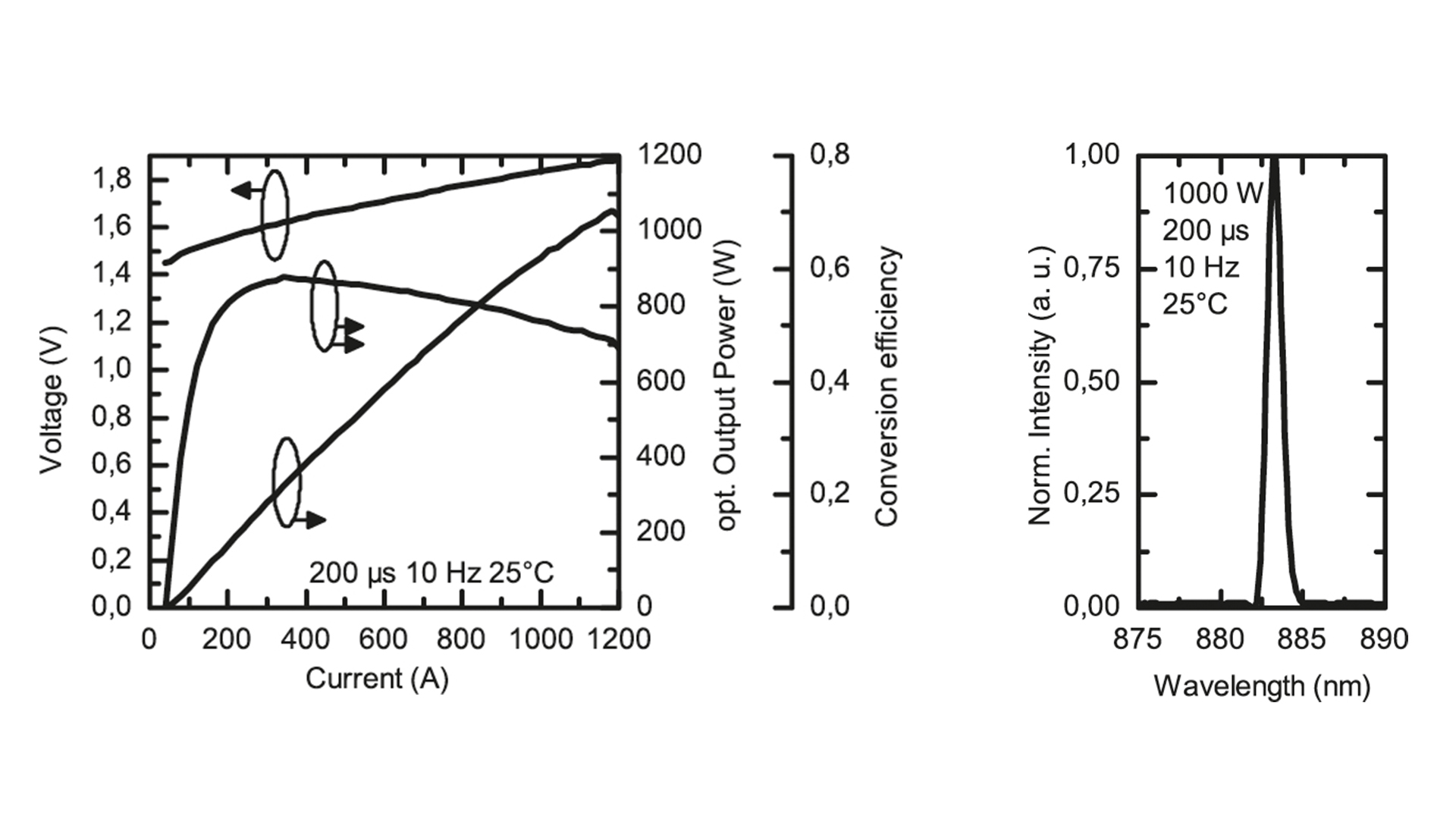
Fig. 2: Left: Measured QCW optical output power (t = 200 µs, f = 10 Hz), voltage and conversion efficiency as a function of bias current for an lc = 88x nm diode laser bar. Right: Measured spatially-integrated intensity as a function of wavelength at Popt = 1000 W (t = 200 µs, f = 10 Hz).
High‑power diode lasers (HPDLs) are a key enabling technology for inertial fusion energy (IFE) power plants- This technology has the potential to provide essentially unlimited, climate-friendly electricity.
FBH scientists are playing a key role in realizing higher power, higher yield and hence lower cost HPDLs for the emerging IFE industry. Their work focuses on four areas: (1) more robust power-scaled III-V technology; (2) new approaches for realizing HPDLs with high fabrication yields, (3) innovative device designs for step-improved output power and (4) techniques for rapid qualification of innovative diode lasers to enable early commercial use in large systems.
Commercial IFE will require many millions of high-power diode lasers, and very stringent targets in cost, efficiency, and lifetime must be met. Specifically, HPDL costs near 0.01 $ / W (ca. 20x below current levels), electrical‑to‑optical efficiencies of ≥ 70 % at kW-per-bar power levels (currently only possible at ca. 0.5 kW), and operational lifetimes in the 10‑20 Gigashot range (unproven) [1] will be needed.
To meet these needs, first, the foundation must be established, namely robust power-scaled III-V technology. Recent FBH studies show strong progress, starting with facet passivation. Many IFE designs require HPDLs with wavelengths around 88x nm, where facet passivation is especially challenging due to the high aluminum content of the epitaxial layers. References [2,3] present an improved version of our air-cleave passivation process. For the first time, it enables 88x nm single-emitter diode lasers with 200 µm stripe widths to operate at 40 W output power with lifetimes beyond two Gigashots (250 µs, 100 Hz), as seen in the aging data in Fig. 1. Such technology could allow 1 cm bars to reliably deliver powers above 1.5 kW – around three times higher than current commercial systems – and enable cost reduction in €/W of up to a factor of three.
The second focus is new approaches for high-yield. For example, HPDLs with monolithically integrated gratings (“grating inside”) could eliminate a major yield loss for large systems: diode laser wavelength targeting. We have demonstrated an important milestone in this area: For the first time, we demonstrated an 88x nm “grating inside” bar delivering 1000 W output power in a narrow spectrum (QCW test, 200 µs, 10 Hz), as shown in Fig. 2 and reported in [3,4].
The third focus is on innovative diode laser designs. Multi‑junction diode lasers are an especially exciting option for IFE. In their most advanced form, they integrate multiple active regions within a single vertical waveguide, also with “grating inside”. Such coupled multi‑junction HPDLs enable strong power scaling and a very narrow spectrum while preserving beam quality. They are already used in short-pulse (ns) LIDAR applications, where multi-junction 1 cm bars from the FBH at around 905 nm have long demonstrated multi-kilowatt power levels, whilst we recently demonstrated that single emitters can achieve roughly tenfold higher power densities (400 W from a 200 µm stripe [5]). Currently, our research is working to adapt these designs to operate with high efficiency at high heat at 88x nm, an approach that could eventually enable 10x power scaled bars with ca. 10x lower cost, as a major contributor toward realizing economic power generation via in future IFE systems.
Fourth, enabling use in the application. Innovative HPDLs can only find IFE application if they can be rapidly and economically qualified for commercial use in large laser systems. This requires internationally agreed standards, which are currently lacking. The international IFE‑STARFIRE Diode Laser Working Group [6] (co-chaired by FBH and Lawrence Livermore National Labs, USA) is addressing this gap, with a first draft method for qualifying diodes lasers for fusion presented in [3].
FBH’s technology developments efforts are supported by the BMFTR project “DioHELIOS”, funded by Germany’s “Fusion 2040” initiative, and coordinated by TRUMPF.
Publications
[1] P. Crump, W. Fenwick, M. Elattar, I. Tamer, K. Häusler, M. Nelson, J. E. Boschker, A. Knigge, R.J. Deri, “Diode laser pumps for future inertial fusion energy systems: status and perspectives,” Optics Express 33(22), 46456-46470 (2025).
[2] P. Crump, P. Della Casa, R.-S. Unger, D. Martin, A. Maaßdorf, K. Haberland, M. Binetti, C. Lörchner-Gerdaus, H. Rupapara, J. Boschker, J. Glaab, C. Zink, S. Einfeldt, A. Knigge, M. Weyers, “Diode Laser Technology for Inertial Fusion Energy: Techniques for Scaling Yield and Power”, Proc. IEEE Phot. Conf. (IPC 2025), Singapore, Singapore, paper TuB1.3 (2025).
[3] P. Crump, S. Arslan, A. Luferau, E. Bahat Treidel, J. E. Boschker, B. Eppich, K. Häusler, A. Maaßdorf, R.-S. Unger, D. Martin, and A. Knigge "Perspectives on the performance scaling of high-power diode laser pumps for use in inertial fusion energy systems", Proc. SPIE 13876, 138760J (2026) (Invited).
[4] P. Crump, “High-power diode lasers for fusion energy applications: perspectives from research and industry,” Proc. Compound Semiconductor Week Conference, Kumamoto, Japan, May 24-28, paper MoD3-01 (2026) (invited).
[5] N. Ammouri, H. Christopher, A. Maaßdorf, J. Fricke, A. Ginolas, A. Liero, H. Wenzel, A. Knigge, G. Tränkle, “420 W pulse power from a 905 nm distributed bragg reflector laser with multiple active regions and tunnel junctions,” Phys. Scr., 100(7), pp. 075514 (2025).