Miniaturized optical isolators for next-generation quantum photonic systems
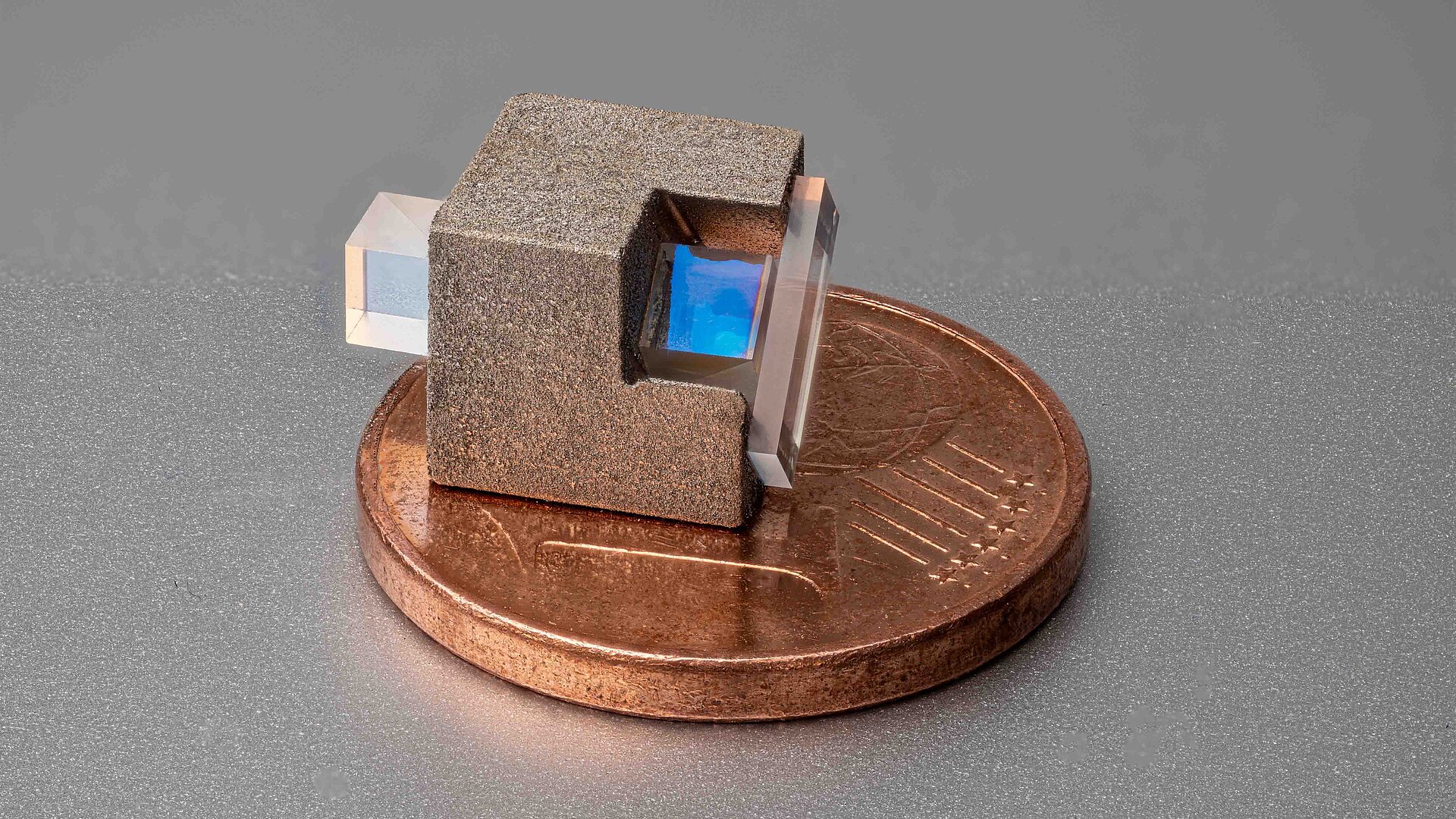
Fig. 1: Our miniaturized optical isolator on a one-cent coin for size reference.
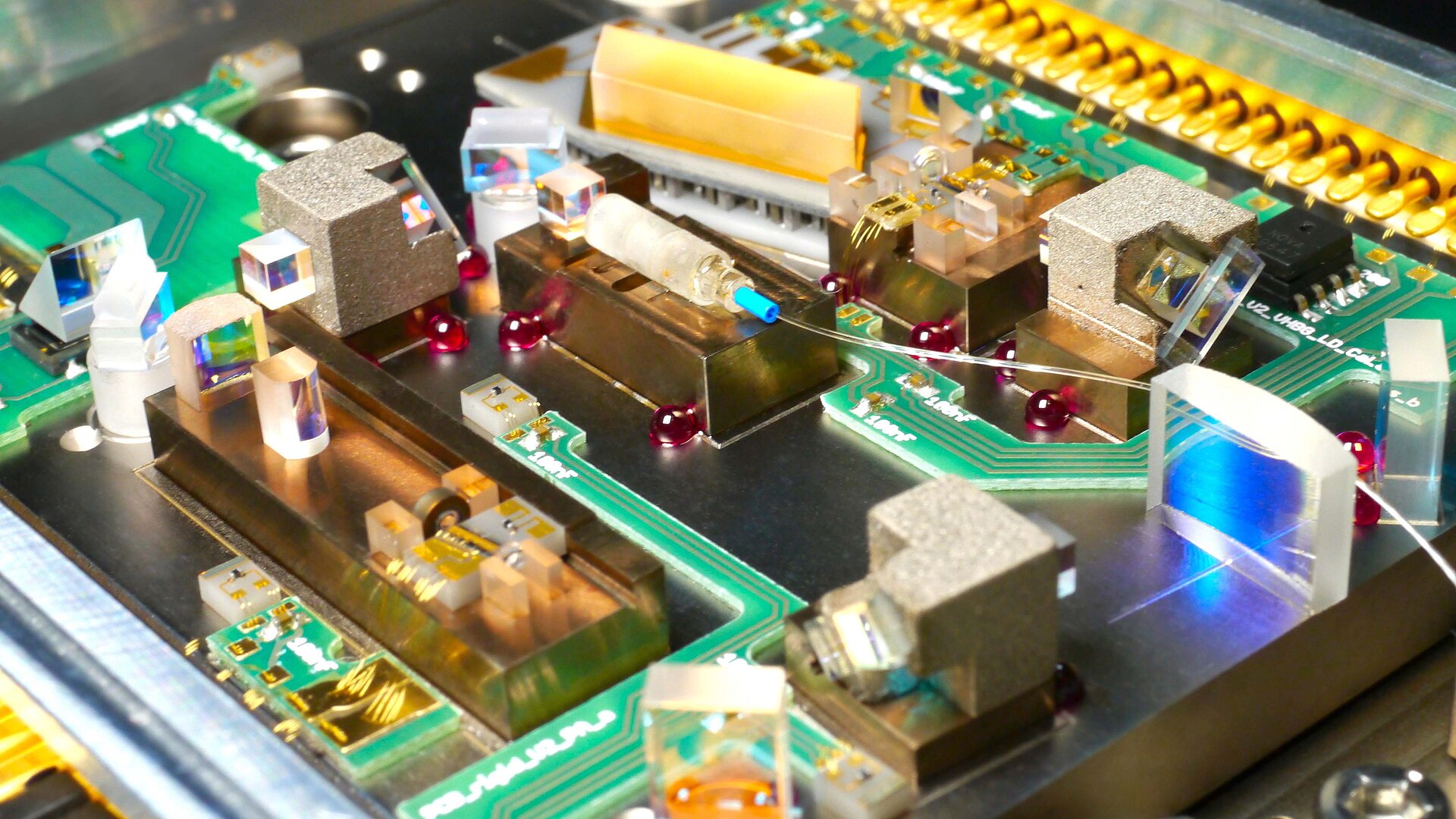
Fig. 2: One of our next-generation lasers for 689 nm. The ECDL module features three of our miniaturized isolators.
As quantum technologies transition from laboratory environments to real-world applications, there is an increasing demand for photonic systems that are compact, robust and suitable for deployment in harsh conditions, such as space or mobile field settings. Optical isolators are key components, particularly in narrow-linewidth laser modules, as they protect the photonic semiconductor components from harmful feedback. However, commercial isolators often fail to meet the requirements of miniaturized quantum photonic modules, especially with regard to footprint and coverage of relevant quantum wavelengths.
To address this issue, researchers at FBH have developed a technology platform for ultra-compact optical isolators, designed for integrated quantum photonic systems (see Fig. 1). Our devices deliver exceptional performance – providing over 30 dB of isolation with insertion losses below 1.5 dB – across a broad spectral range from 400 to 950 nm, all within a volume of less than 0.5 ml (see Table 1). Unlike conventional solutions, the platform enables wavelength-specific design within a consistently miniaturized architecture, making it suitable for a wide range of quantum photonic applications. This level of miniaturization is made possible by using magneto-optical materials such as cadmium manganese telluride (CdMnTe), which offer high Verdet constants and low optical loss coefficients across the desired wavelength range. Sufficient Faraday rotation within a short optical path length is achieved by combining various magneto-optical crystals with optimized permanent magnet designs. This approach enables the miniaturization of the single-stage isolators and allows us to adapt each component to the target wavelength. The assembly also includes two miniature polarizing beam splitter cubes and a half-wave plate. All components are actively aligned and bonded using FBH’s hybrid micro-integration technology to ensure optimum performance.
| Wavelength | Isolation | Insertion loss | Transmission |
| 461 nm | > 32 dB | 1.4 dB | 73 % |
| 689 nm | > 31 dB | 1.2 dB | 76 % |
| 698 nm | > 32 dB | 1.4 dB | 73 % |
| 854 nm | > 33 dB | 1.5 dB | 71 % |
Table 1: Measured performance values for the miniaturised optical isolators we have realised at various wavelengths.
The suitability of the isolators has already been demonstrated in practical applications. Three devices were integrated into one of our next-generation laser modules (see Fig. 2). The system delivers over 50 mW of power via a polarization-maintaining fiber at 689 nm for strontium spectroscopy. Another device operating at 698 nm was successfully integrated into the Quick³ mission on board a nanosatellite. This experiment aims to test a single-photon source for quantum communication in space. To make it compatible with the satellite’s requirements on the emitted magnetic field strength, the isolator was equipped with a custom magnetic shield. Launched in June 2025, the mission demonstrates the suitability of our isolator for use in orbit.
By successfully developing a technology platform for wavelength-matched optical isolators in the visible and near-infrared range, FBH has closed a crucial gap in miniature photonic components for quantum technologies. We are now manufacturing optical isolators for additional wavelengths to further expand our capabilities and realize ultra-compact photonic modules.
This work was supported by the DLR Space Administration with funds provided by the Federal Ministry for Economic Affairs and Energy under grant numbers 50WM2261B and 50WM2351C.
Publications
M. Bursy, A. Bawamia, T. Flisgen, N. Goossen-Schmidt, C. Luplow, M. Schiemangk, C. Tyborski, A. Wicht, “Miniaturised Optical Isolators for Realising Micro-Integrated Photonic Modules in Quantum Technology Applications”, Proc. of 2025 Conference on Lasers and Electro-Optics Europe & European Quantum Electronics Conference (CLEO/Europe-EQEC).
S. Schwertfeger, E. Da Ros, M. Bursy, A. Wicht, D. Pardo, A. Sharma, S. Sachidananda, A. Ling, M. Krutzik, “A 698 nm laser system for excitation of fluorescent quantum light sources on a CubeSat mission”, Acta Astronaut., vol. 243 (2026).