FBH to present latest advances at Photonics West 2026
At Photonics West 2026 in San Francisco (USA), the Ferdinand-Braun-Institut (FBH) will once again showcase new technological achievements. The FBH will exhibit at the trade fair (January 20 to 22, 2026) and deliver 20 scientific presentations at the accompanying conferences (January 17 to 22, 2026). At booth 4205-14 in the German Pavilion, the research institute will present its full portfolio, from device design to prototype development and small-series production. A key highlight remains its chip technology. Among recent breakthroughs: FBH has successfully expanded the wavelength range of gallium arsenide (GaAs)-based lasers from 620 to 614 nm, which is of particular relevance for quantum computing. This wavelength enables the reset of barium ions used as qubits in quantum processors. Additional focus areas include tailored modules and systems, supporting applications such as direct material processing, hyperspectral imaging in the mid-infrared using entangled photon pairs, and solutions designed for deployment in space.
Photonic integration based on gallium arsenide
The FBH ranks among the world’s leading research institutes in chip design and the fabrication of gallium-arsenide-based diode lasers. It has developed a monolithic GaAs-based photonic integrated waveguide platform that combines on-chip amplification with passive, shallow, and deep-etched waveguides. This technology provides the foundation for ring-resonator-coupled lasers and can cover a wavelength range from 950 nm to 1180 nm. Potential applications include quantum physics, spectroscopy, and biosensing, areas among others.
High-power diode lasers – from advanced chips to real-life industrial testing
FBH has continued successful field trials of its SAMBA laser head, demonstrating metal 3D-printing of test structures directly at an industrial partner’s site. At the core of this direct diode laser system is a compact module providing 1 kW continuous-wave (CW) output power. Its 780 nm wavelength is tailored to the absorption peak of aluminum. In parallel, the team at FBH has introduced lasers with narrower stripe widths and shorter resonators, raising CW conversion efficiency at the 1 kW level to 50 %. These improvements also doubled the achievable power density to 2 kW per square millimeter.
Further progress has been achieved in the development of pump laser sources, a key technology for inertial fusion energy (IFE) systems. FBH is employing new device concepts that enhance performance while reducing manufacturing costs. These innovations include multi-junction designs as well as advanced technological approaches for facet passivation and grating stabilization.
At the same time, FBH is steadily advancing its technological foundations, resulting in a substantial increase in the brilliance of broad-area lasers. A customized current profile along the resonator results in a homogeneous device temperature distribution, reducing the lateral far field by 30 % for the first time worldwide.
Modules for demanding space applications
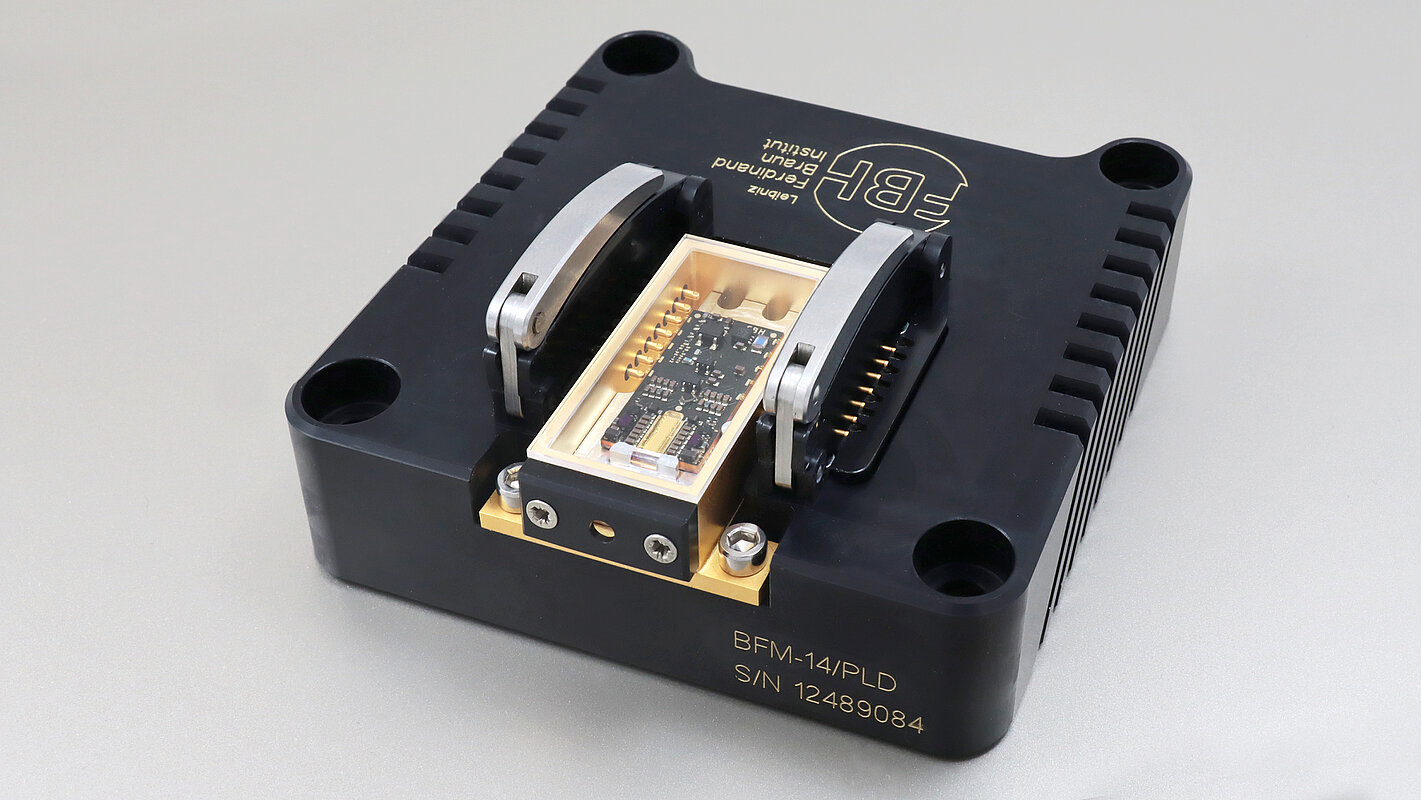
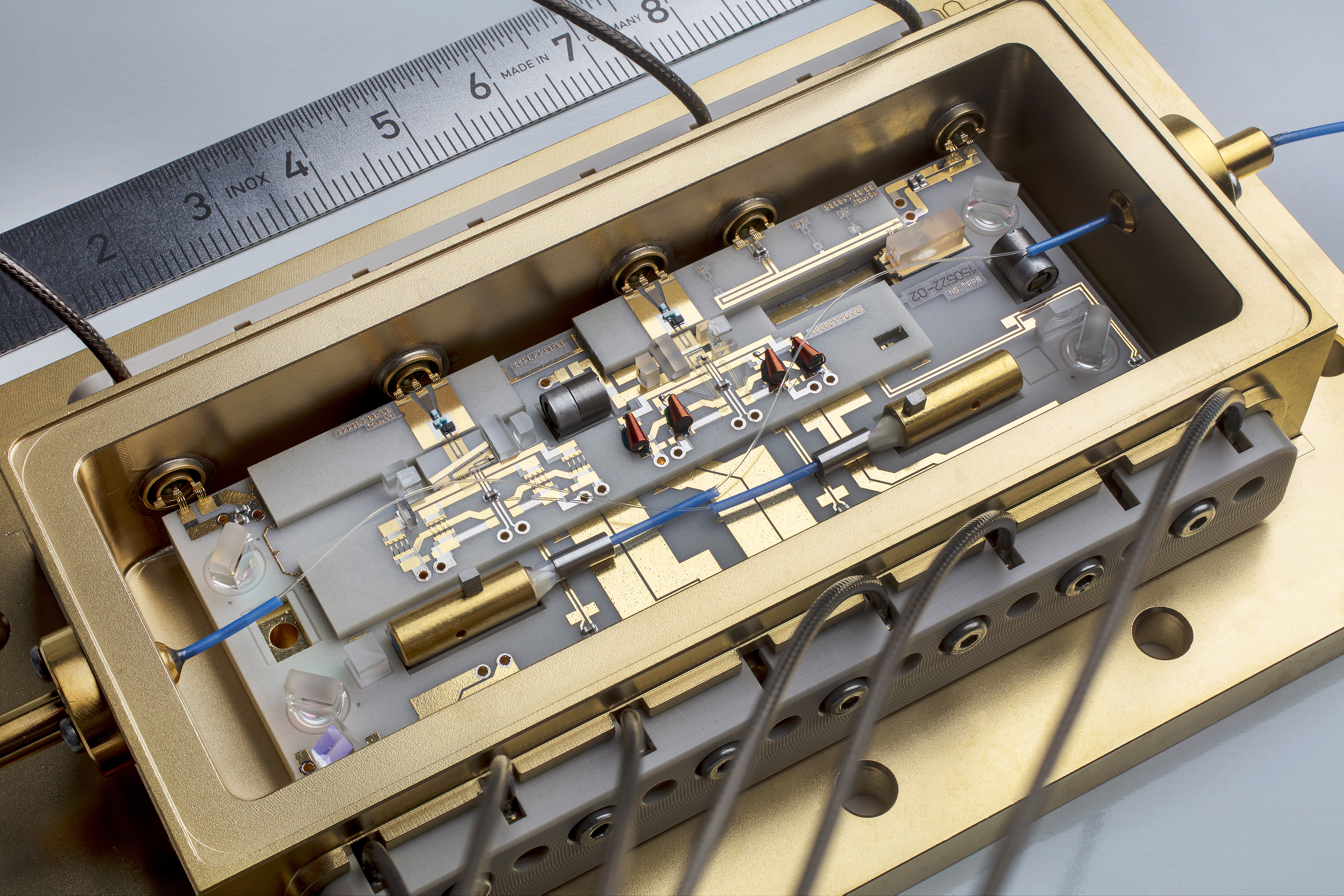
For many years, FBH has been developing and manufacturing diode laser modules for use in challenging environments including space, with their reliability confirmed in multiple microgravity experiments. The institute is currently manufacturing 55 ultra-narrowband modules for the BECCAL apparatus, which will support quantum-optical experiments aboard the International Space Station (ISS). These modules are based on the patented MiLas® technology, developed in-house. Micro-integrated MiLas® laser modules are exceptionally robust and, with dimensions of only 125 mm × 75 mm × 23 mm and a weight of 750 g, extremely compact. They provide output powers above 500 mW with an intrinsic linewidth below 1 kHz. This technology is currently being further developed for use in MEO and GEO satellite orbits with operational lifetimes exceeding 15 years. In parallel, the institute is pushing further miniaturization efforts by transferring the established hybrid External Cavity Diode Laser (ECDL) concept to a single chip to realize a monolithically integrated ECDL (mECDL).
FBH's pulsed nanosecond laser sources for time-of-flight (ToF) LiDAR systems are also aimed at space applications. The distance-measurement modules for mid-range scanning are equally suited for robotics and autonomous driving. They are developed in several variants, each featuring in-house-developed driver electronics tailored to the specific application and delivering high output power along with excellent lateral beam quality. For example, 48-emitter laser bars with a 50 µm stripe width achieve pulse powers exceeding 2,000 W.
Miniaturized and powerful: Isolator with broad wavelength coverage
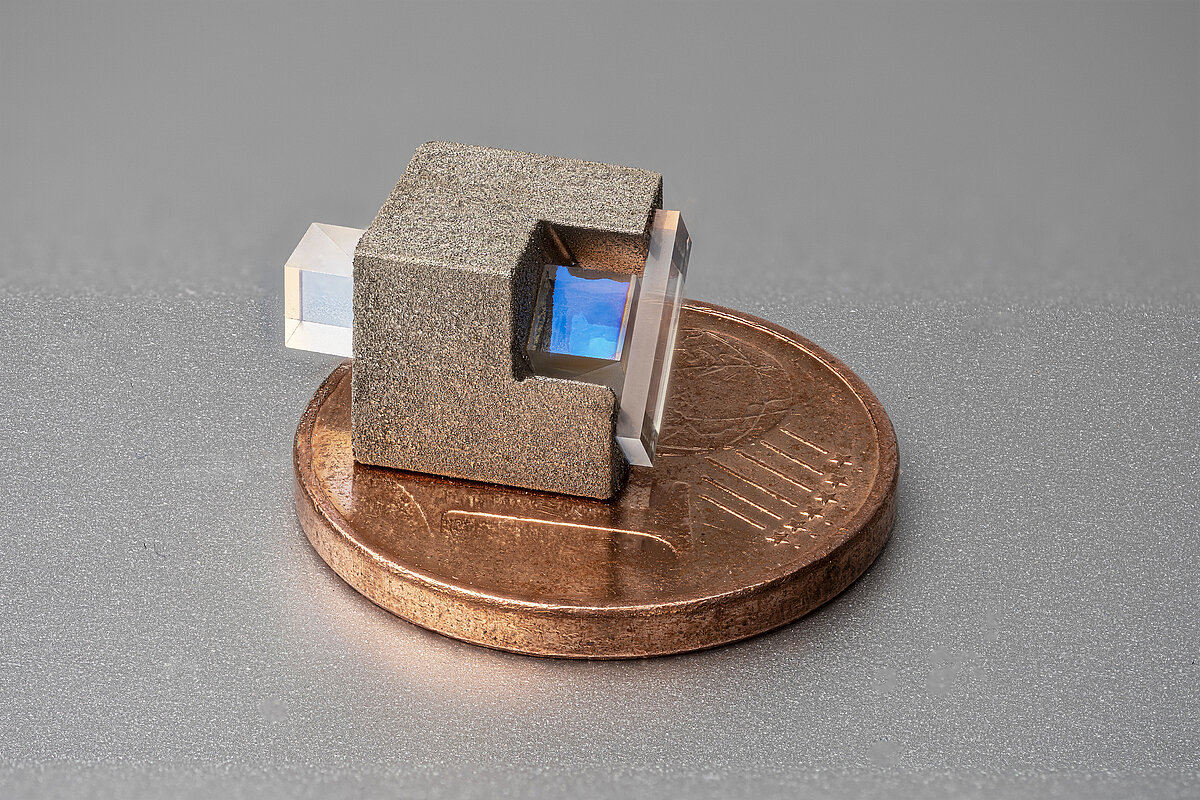
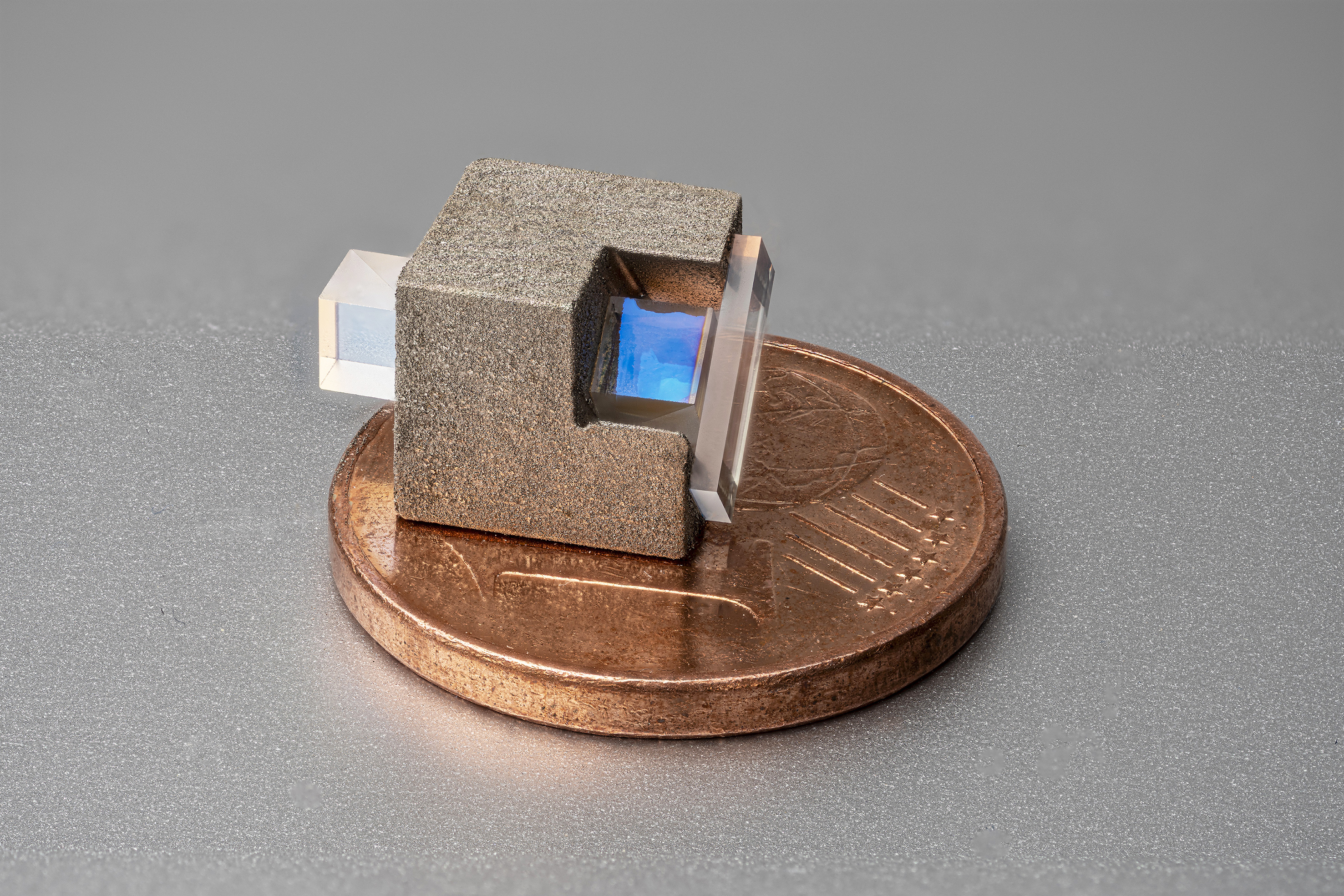
Optical isolators are critical components in semiconductor laser systems, ensuring that emitted light travels only in one direction and protecting the laser from harmful feedback. FBH has developed a technology platform for highly compact isolators with a volume of less than 0.5 ml. These miniaturized components cover a wide wavelength range from around 400 nm to 950 nm and deliver impressive performance, providing more than 30 dB isolation and transmission above 70 %. With this development, FBH closes a gap in the current commercial landscape and enables new applications, including photonic modules for compact quantum computers, high-precision optical clocks, and mobile quantum sensors. One of these isolators has already been deployed in space aboard a nanosatellite.
3D-printed high-performance ceramics for compact, robust quantum sensors
At the trade fair, FBH will also showcase a miniaturized optical frequency reference (OFR), micro-integrated on an additively manufactured high-performance ceramic substrate. All optical components are precisely aligned on 3D-printed ceramic structures and assembled into a rugged system with a total volume of just 6 ml and a mass of 15 g. The performance achieved by the Doppler-free OFR is ideally suited for cold-atom quantum sensor applications.
FBH's demonstrated technology enables complex, precise components with excellent mechanical stability and low weight to be additively manufactured. Vibration- and temperature-stable carrier structures for highly integrated optical and atomic physics systems are thus created. The innovative technology platform demonstrates the potential of 3D-printed aluminum oxide structures and paves the way for next-generation compact, robust, and highly sensitive quantum sensors, capable of reliable operation outside the laboratory. A prototype of an optically pumped magnetometer (OPM) has already been realized on this technology platform with a total volume of only 7 ml.