Miniaturized active optical dipole trap system for compact quantum sensing applications
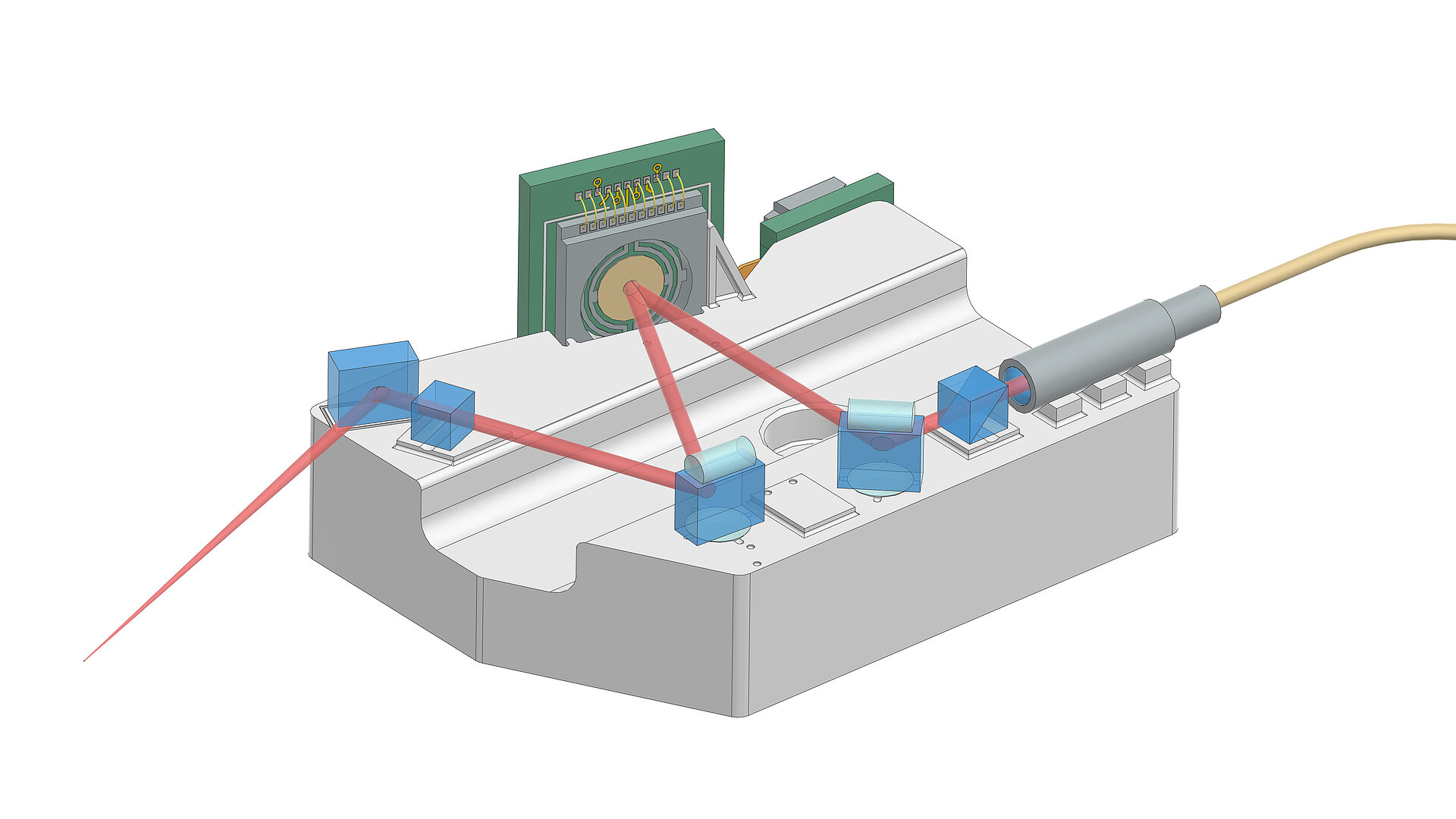
Fig. 1. CAD design of the miniaturized active optical dipole trap system employing a 2D MEMS mirror for dynamic beam steering.
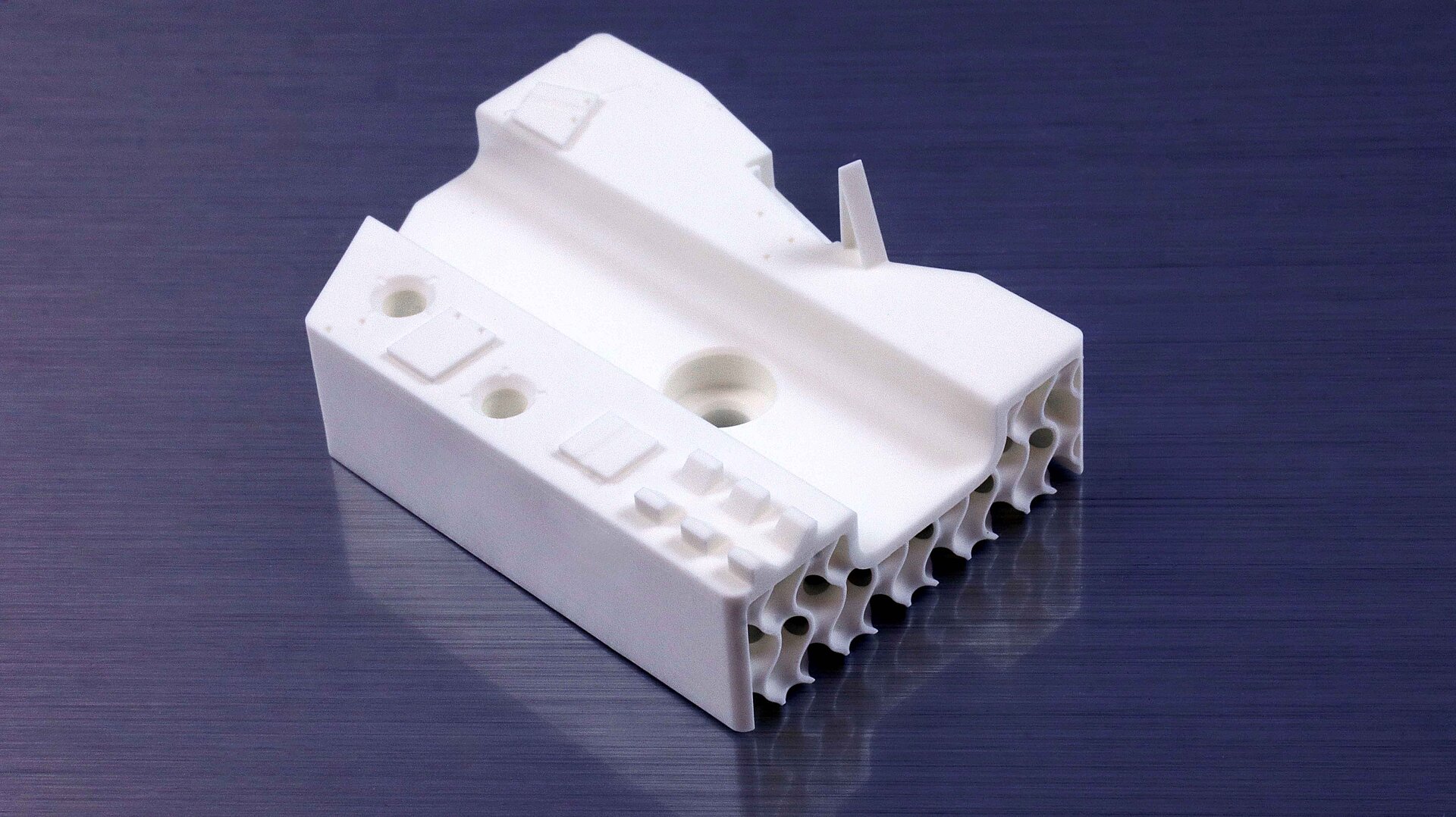
Fig. 2: Additively manufactured micro-optical bench with a footprint of 42 x 31.5 mm² made from Al2O3 ceramics.
On the path towards compact and robust atom-based quantum sensing systems, the Integrated Quantum Sensing (IQS) Group at FBH develops miniaturized optical setups for cooling, trapping and coherently manipulating atomic ensembles. Former developments demonstrated the accuracy and long-term stability of a passive crossed-beam optical dipole trap system realized by adhesive micro-integration developed at FBH [1]. Now, the incorporation of active optical components can increase the system’s functionality in terms of spatial addressability, realignment strategies, and flexible time-averaged potentials.
Within the MOTION project (Mikrointegrierte aktive Optiksysteme für dynamische Atomfallen und -Manipulation) we developed a micro-integrated optical dipole trap system with active beam-steering capabilities employing a piezoelectric MEMS (micro electro-mechanical systems) mirror (Fig. 1). The active manipulation of the beam path is designed to create time-averaged potentials, i.e., to increase the efficiency of optical dipole trapping and evaporation or to create arbitrary potential shapes.
The setup contains a pigtailed fiber-collimator, coupling polarized laser light onto the bench. The light is further conditioned by a polarizing beam-splitter (PBS) and reflected onto the MEMS-mirror provided by Fraunhofer ISIT. The actively steered laser beam gets subsequently reflected and guided through a focusing lens, which translates the steering-angle into a lateral beam-displacement. As a result, the beam focus (w ~ 30 µm) creating the dipole trap behind the optical system is dynamically displaced in its focal plane. The 2D MEMS mirror enables either one-dimensional painting along the main axes of the focal plane or combined two-dimensional painting following a Lissajous pattern, depending on the driving frequencies. The system is designed to operate at optical powers up to 5 W cw at 1064 nm.
The optical setup is assembled on an additively manufactured Al2O3 micro-optical bench with a footprint of 42 x 31.5 mm² (Fig. 2), fabricated using lithography-based ceramic manufacturing (LCM) [2]. The material offers high stiffness and low thermal expansion, resulting in excellent dimensional stability under mechanical or thermal loads. The in-house manufacturing process enables rapid prototyping and freedom of design, especially for small features. Most of the bulk material of the printed substrate is replaced by a gyroid structure, resulting in a lightweight component while maintaining mechanical stiffness and rigidity.
The optical system is intended for operation in a cold atom experiment conducted by our group at Humboldt-Universität zu Berlin. There, it is being investigated as a means to more effectively load 87Rb atoms from a magneto-optical trap (MOT) into the optical dipole trap.
Further applications of the technology include compact ultra-cold atom systems, creating Bose-Einstein condensates (BEC), which could enable long-lived quantum memories in space [3].
This work is supported by the German Space Agency (DLR) with funds provided by the Federal Ministry of Research, Technology and Space (BMFTR) under grant number DLR 50WM1949, 50RK1978, 50WM2070, and 50WM2268.
Publications
[1] M. Christ, O. Anton, C. Zimmermann, V. A. Henderson, E. Da Ros, M. Krutzik, “Micro-integrated crossed-beam optical dipole trap system with long-term alignment stability for mobile atomic quantum technologies”, Optics Express, 32 (23) (2024).
[2] M. Christ, C. Zimmermann, S. Neinert, B. Leykauf, K. Döringshoff, M. Krutzik, “Additively manufactured ceramics for compact quantum technologies”, Advanced Quantum Technologies, 7 (12) (2024).
[3] E. Da Ros, S. Kanthak, E. Sağlamyürek, M. Gündoğan, M. Krutzik, “Proposal for a long-lived quantum memory using matter-wave optics with Bose-Einstein condensates in microgravity”, Physical Review Research, 5 (3) (2023).