Laser facet passivation enables reliable high-power red ridge waveguide laser diodes
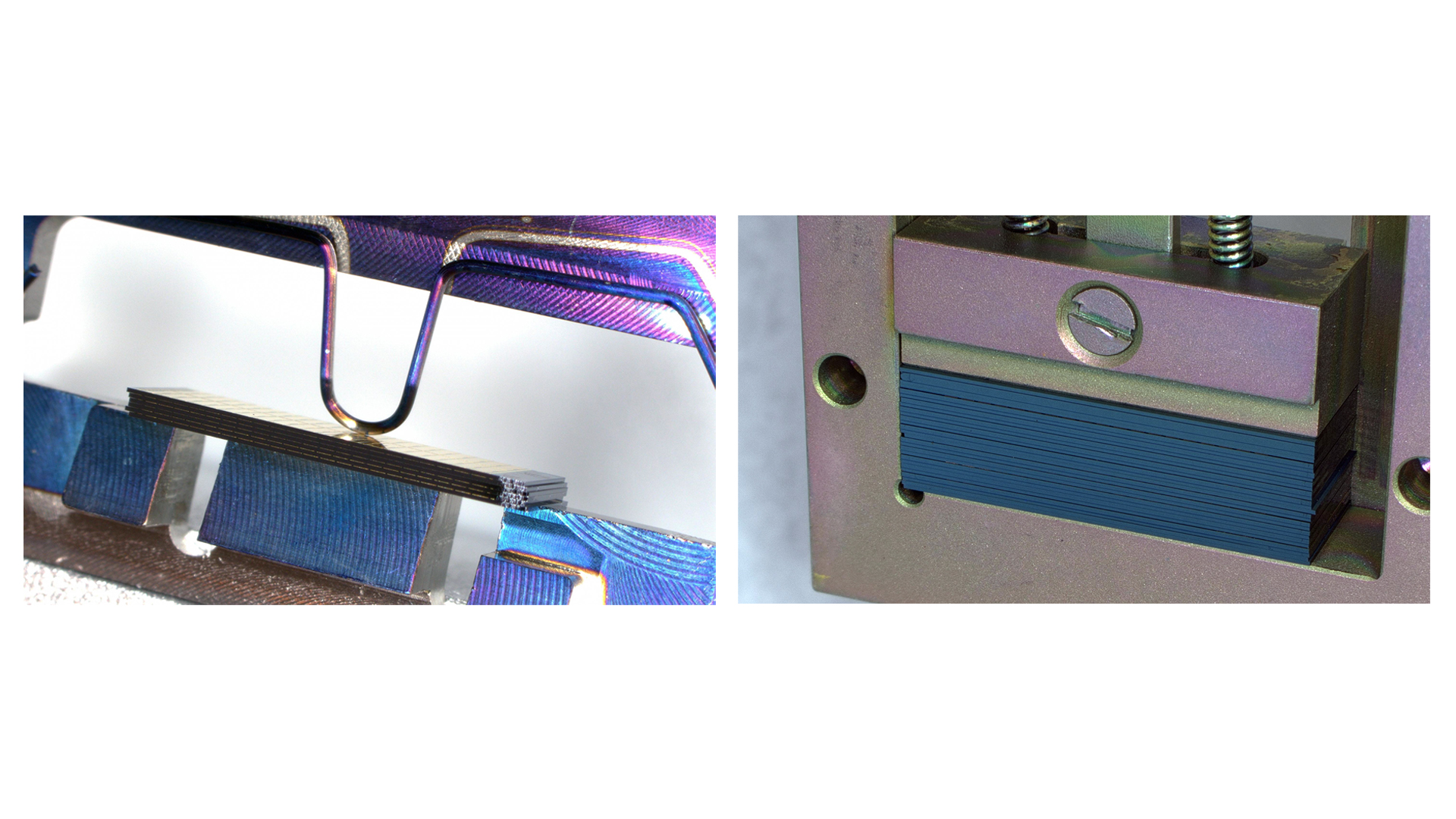
Fig. 1. Laser bars stacked in ultra-high vacuum (left) und laser bars processed using hydrogen cleaning (right).
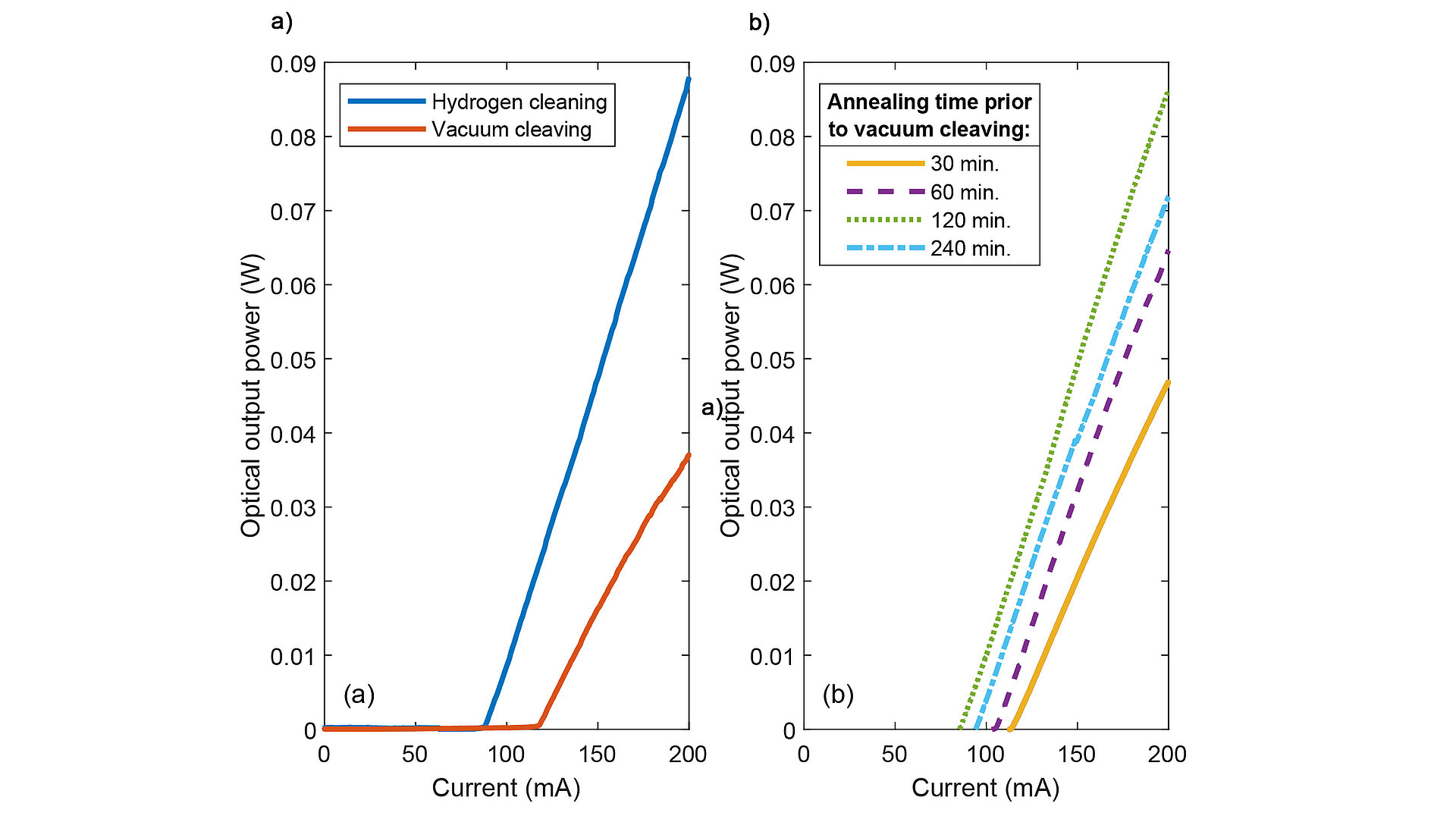
Fig. 2. Optical power as a function of current for 635 nm ridge waveguide lasers. (a) Comparison of lasers passivated using hydrogen cleaning and vacuum cleaving. (b) Comparison of different ex situ annealing times at 300° C prior to vacuum cleaving.

Fig. 3. Lifetime tests of 635 nm ridge waveguide lasers passivated using (a) hydrogen cleaning and (b) vacuum cleaving after 120 minutes of ex situ annealing at 300° C. Each aging experiment consists of at least two diodes. For vacuum cleaving, two aging experiments were performed (blue and orange curves, respectively). One diode from experiment 1 was stopped after 3275 hours, the other after 5225 hours. All diodes from experiment 2 were stopped after 4370 hours.
GaAs-based lasers emitting in the red spectral range are attractive for applications such as holography, laser displays, spectroscopy, and two-photon up-conversion. They also serve as light sources for pumping. These applications require lasers with higher output powers and/or shorter wavelengths than currently available. However, commercial use strongly depends on the operational lifetime of the devices. In general, lifetime decreases as output power increases. Laser facet passivation is an essential aspect of the fabrication process for edge emitting lasers, because it determines both the maximum power output and the device lifetime.
Recently, we investigated two state-of-the-art methods for laser facet passivation – hydrogen cleaning and vacuum cleaving, both with subsequent ZnSe passivation. Partly and fully processed bars using these processes are shown in Fig. 1. We applied these methods to ridge-waveguide lasers (RWLs) emitting at 635 nm [1]. RWLs fabricated using vacuum cleaving initially showed lower performance than those treated with hydrogen cleaning (Fig. 2a). However, after optimizing the annealing time prior to vacuum cleaving, we achieved comparable performance (Fig. 2b). This indicates that the performance of red lasers depends on the thermal budget during fabrication. Control of the thermal budget is therefore essential for optimizing device performance.
We then assessed the stability of the RWLs by means of lifetime measurements (Fig. 3). The tests started at an output power of 20 mWatt. After one week, we increased the power in steps of 10 mWatt. RWLs passivated by means of hydrogen cleaning failed at 110 mWatt. Subsequent inspection revealed that the failure had occurred at the laser facet. In contrast, RWLs passivated by means of vacuum cleaving did not fail and could be operated up to 200 mWatt or for 2000 hours at 160 mWatt. This demonstrates that vacuum cleaving and subsequent ZnSe passivation result in superior facet stability compared to hydrogen cleaning.
Based on this approach, we were also able to demonstrate stable CW operation of 626 nm RWLs with an output power of 140 mWatt [2]. Devices with such wavelengths are attractive for future quantum technology applications.
Publications
[1] J. E. Boschker, D. Feise, U. Spengler, P. Ressel, K. Paschke, A. Knigge, “Influence of the Passivation Method on the Performance of 635 nm Ridge Waveguide Lasers,” IEEE Photonics Journal, vol. 17, no. 2, pp. 1–4, Apr. 2025, doi: 10.1109/JPHOT.2025.3542598.
[2] F. Mauerhoff et al., “Continuous wave operation of broad area and ridge waveguide laser diodes at 626 nm,” IET Optoelectronics, vol. 18, no. 5, pp. 140–145, 2024, doi: 10.1049/ote2.12125.