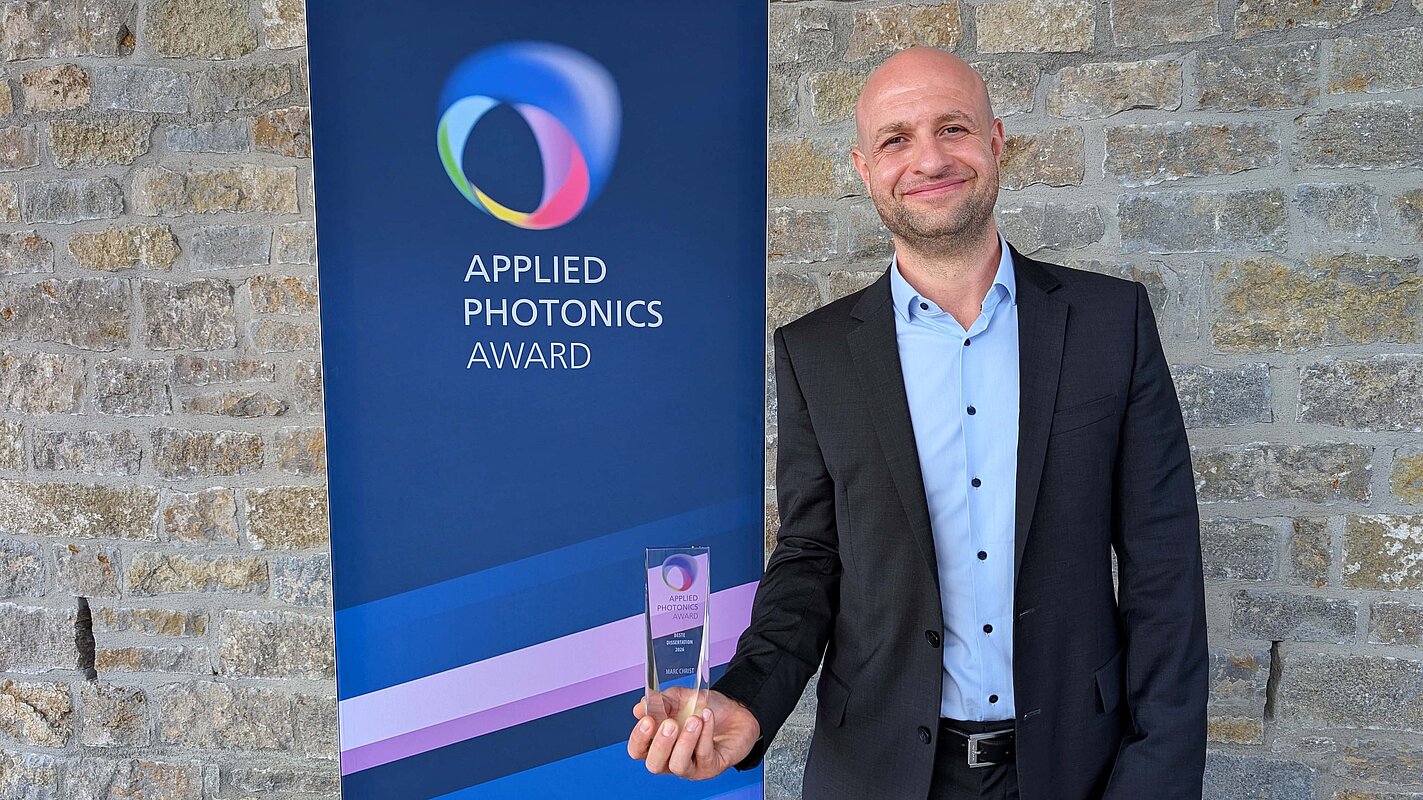
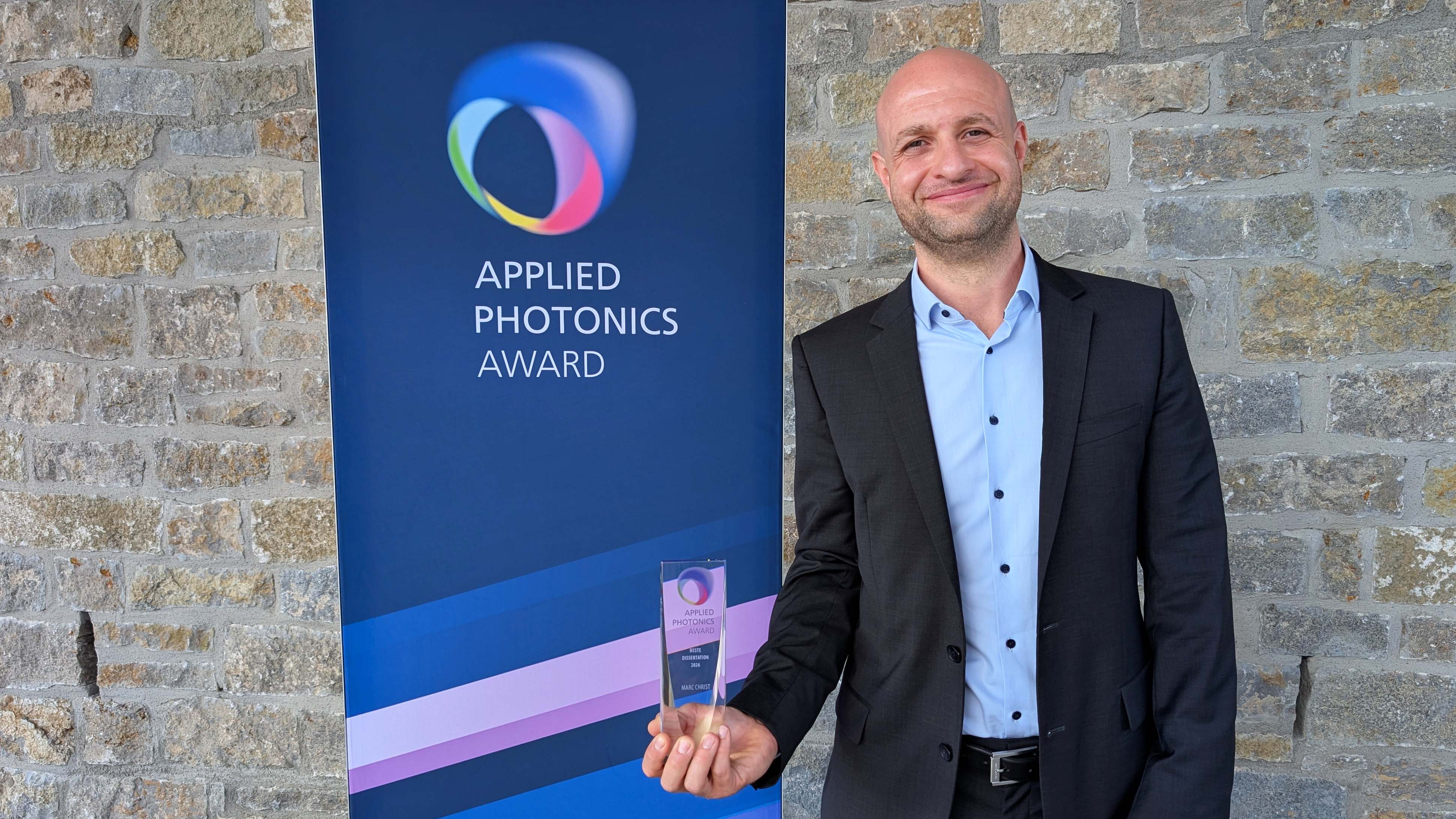
Marc Christ receives Applied Photonics Award 2026 for his dissertation on compact atomic quantum sensors
The award recognizes outstanding scientific achievements in applied photonics. In his doctoral thesis, Marc Christ developed a technology platform that makes key components of atomic quantum sensors smaller, more robust, and suitable for practical applications. He demonstrated and validated the performance of the approach using several demonstrators.
Atomic quantum sensors can measure time, frequency, and magnetic fields with extremely high precision. To achieve this, laser light, atoms, and optical components must interact with exceptional accuracy. Such systems have traditionally relied on complex laboratory setups. In his dissertation, Marc Christ developed a technology platform that enables key photonic and atom-optical components to be implemented in a compact, robust, and long-term stable form. His approach combines optical micro-integration with 3D-printed technical ceramics. He also qualified materials and integration processes for demanding environmental conditions and vacuum applications.
Marc Christ received the 2026 Applied Photonics Award for the best dissertation during Photonics Day Jena on September 15. His doctoral thesis is entitled “Micro-integrated optical systems, additive manufacturing, and vacuum integration for atomic quantum sensors.” At the Berlin-based Ferdinand-Braun-Institut (FBH), Christ works in the Joint Lab Integrated Quantum Sensors. There, he leads the “Enabling Technologies” team, which develops key technologies for compact atomic quantum sensors.
Making quantum sensors more compact and suitable for practical applications
The technology platform addresses key challenges in transferring atomic quantum sensors and related quantum technologies from the laboratory into practical applications. It lays the foundation for compact, robust, and long-term stable systems. In his dissertation, Marc Christ demonstrated this potential with miniaturized modules that bring laser light, atoms, and precision micro-optics together within a very small volume. In the future, such sensor modules could enable high-precision time and frequency measurements or serve as the basis for compact magnetometers. Potential applications range from medical diagnostics, including non-invasive measurement of muscle activity, to navigation, Earth observation, and natural resource exploration.
Operating quantum sensors reliably outside the laboratory places high demands on their sensitive technology. Vacuum conditions, temperature fluctuations, and mechanical loads must not affect either the optical alignment or the atomic functionality. The approach therefore combines optical micro-integration with stable ceramic substrate structures and qualified assembly processes. This makes the resulting compact quantum sensors easier to integrate into larger systems and operated with reduced alignment and maintenance requirements. This enables high-precision quantum sensors to be used in environments where conventional laboratory setups reach their limits, for example on mobile platforms or in space.
About the award
The Fraunhofer Institute for Applied Optics and Precision Engineering IOF organizes the Applied Photonics Award. This award recognizes outstanding theses that focus on commercially viable optical technologies. A panel of experts, consisting of representatives from academia and industry, selects the winners. The prize for the best dissertation is endowed with 3,000 euros.