Far-UVC LEDs transmit data at record speed
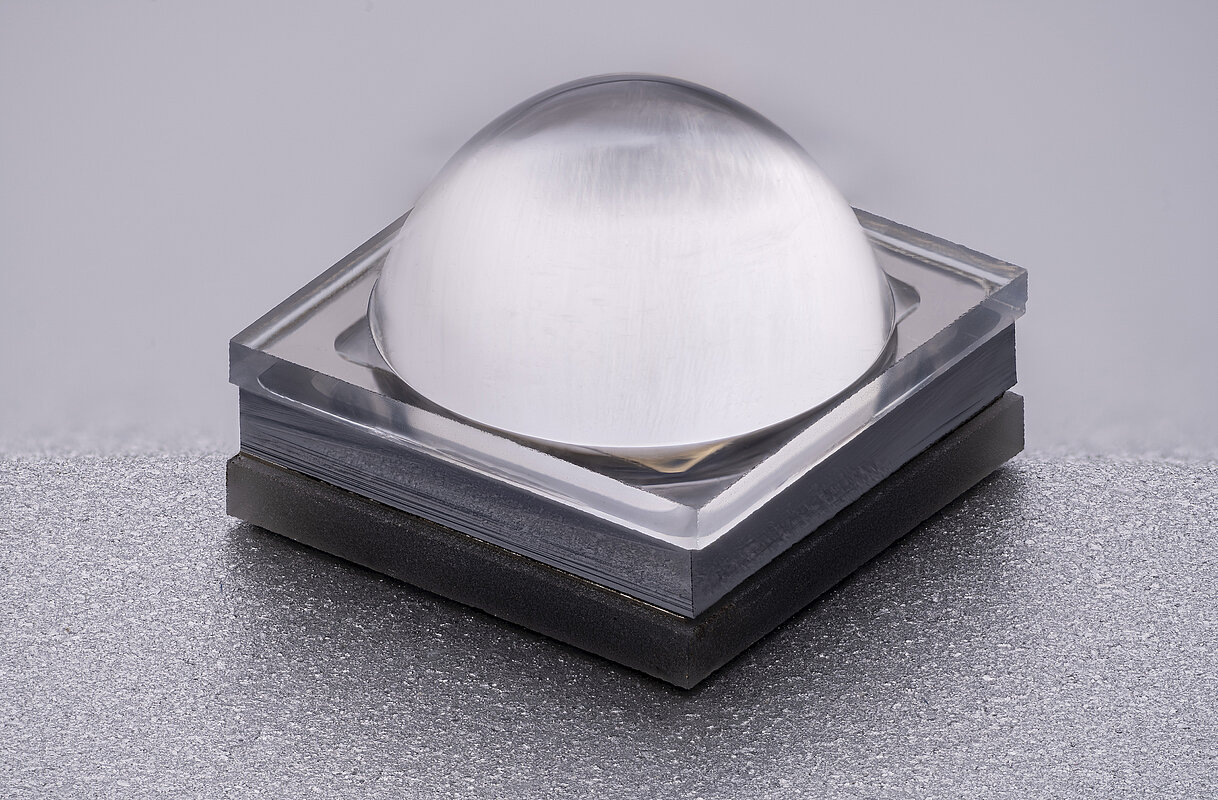
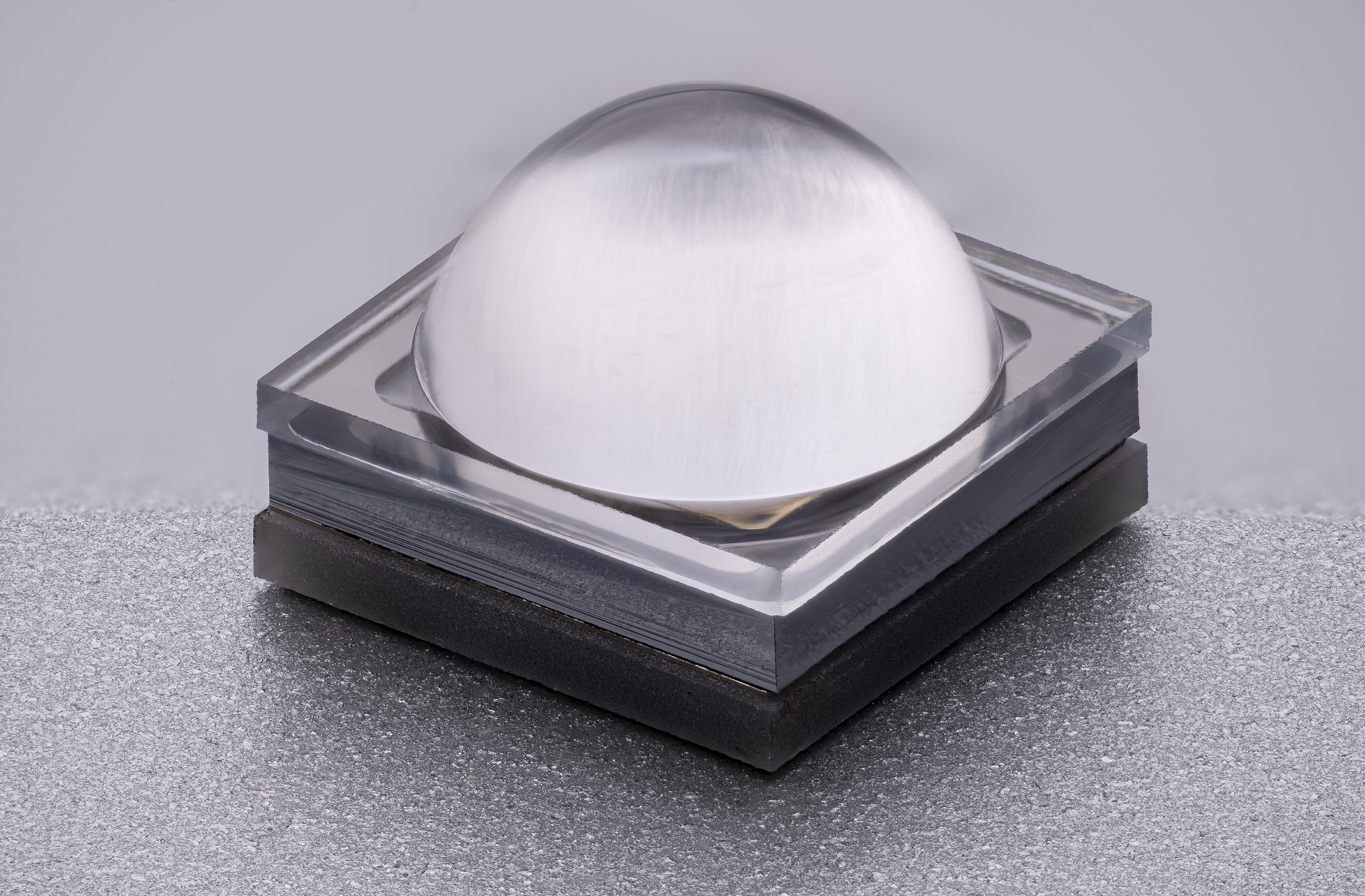
Researchers at Ferdinand-Braun-Institut (FBH) in Berlin, the Institute of Photonics at University of Strathclyde, and the LiFi Research and Development Centre at University of Cambridge have transmitted data at up to 1.5 gigabits per second using novel far-UVC LEDs. The devices, developed at FBH, set a record for wireless optical communication at wavelengths below 235 nanometers. Far-UVC technology offers a distinct advantage for outdoor communication: Sunlight generates virtually no background signals in this spectral range. The technology could therefore enable reliable optical links outdoors and complement radio-frequency communication where it reaches its limits.
Autonomous vehicles and drones, connected industrial machinery, robotics, and civil protection applications all depend on reliable wireless data connections. At the same time, more and more systems compete for limited frequency bands. Optical wireless communication can therefore effectively complement radio frequency technologies. Systems using visible or infrared light, however, face a major challenge outdoors. The sun also emits radiation in these wavelength ranges. This solar background can interfere with optical signals and make reliable data transmission difficult. As a result, such systems often require precisely aligned laser beams.
UVC communicates without interfering solar background
UVC light offers a decisive advantage. At wavelengths below 280 nanometers (nm), virtually no solar radiation reaches the Earth’s surface since it is absorbed in the upper layers of the atmosphere. As a result, optical wireless communication using UVC light is largely free of interfering background signals from the sun.
For their experiments, the researchers used far-UVC light at wavelengths below 235 nm. This radiation is strongly absorbed in the outer, non-living layers of the skin and penetrates living tissue much less deeply than longer-wavelength UV radiation. This type of UV light is therefore considered safe for human health and suited for applications in close proximity to humans.
Optimized far-UVC LEDs enable viable data rates
“We have optimized our LEDs specifically for optical communication in this spectral range,” says Dr. Jan Ruschel, senior scientist at Ferdinand-Braun-Institut (FBH). “They deliver high optical power in international comparison and can be modulated particularly quickly. This makes them well suited for optical data exchange both indoors and outdoors.”
To this end, the FBH team segmented the emitting surface of its far-UVC LEDs into many small areas. The smaller areas reduce the junction capacitance and increase the current density. As a result, the LEDs achieve a higher modulation bandwidth than conventional devices with large emitting areas.
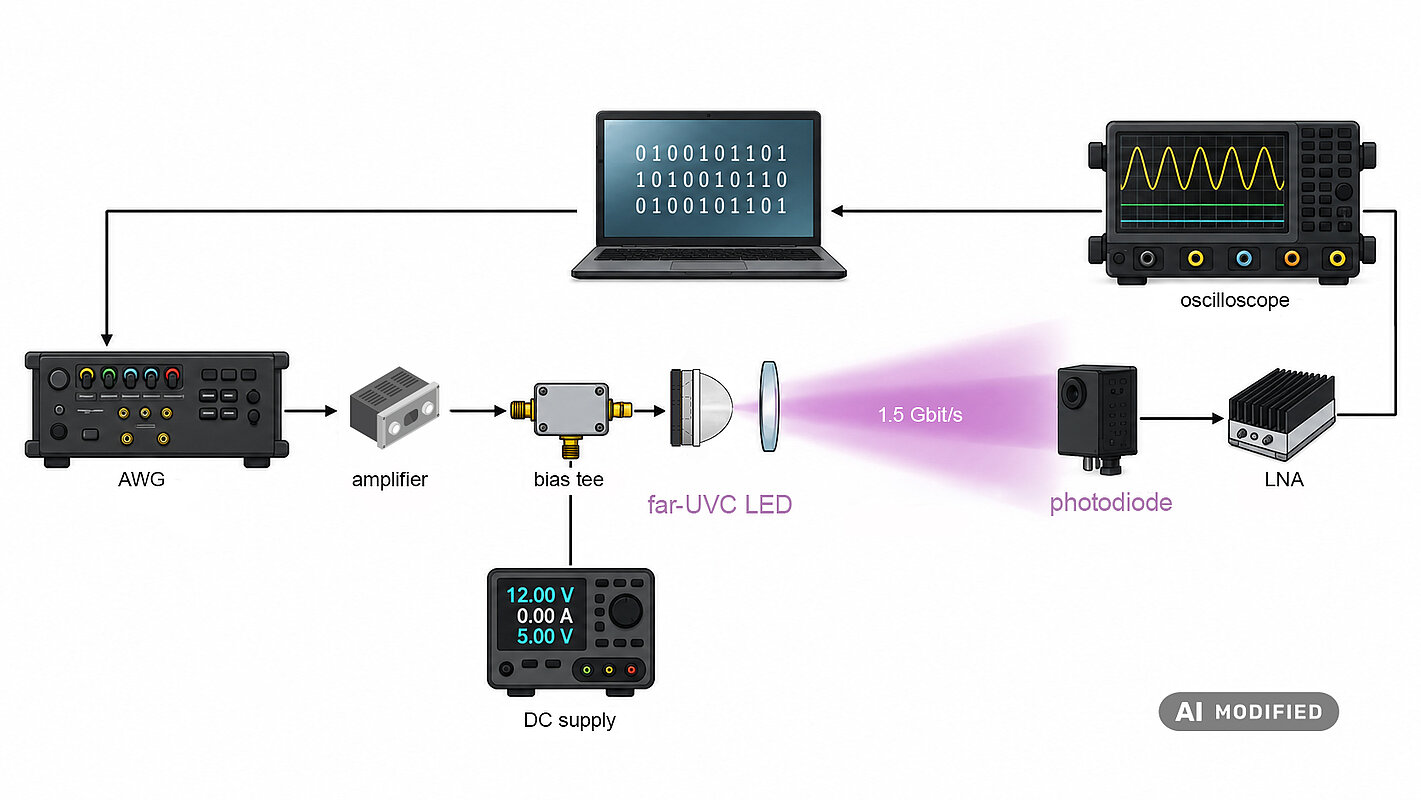
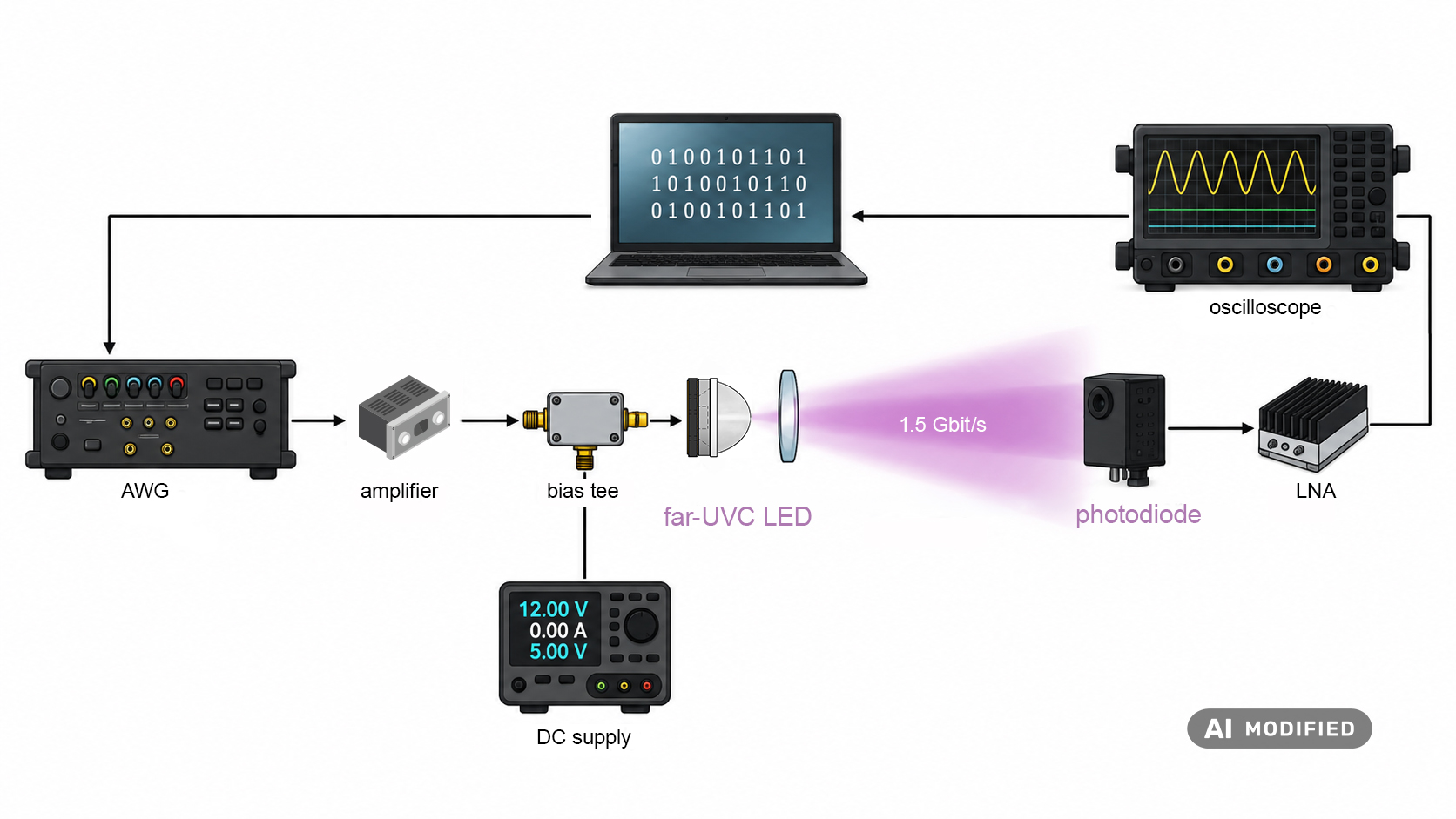
Researchers at the University of Strathclyde and the University of Cambridge used these LEDs to build and test an optical wireless communication system. With a direct line of sight between transmitter and receiver, the system transmitted data over a distance of 30 centimeters at rates of up to 1.5 gigabits per second. Conducted under ambient room lighting, these measurements set a record for data transmission at such short wavelengths. The work was carried out as part of TITAN, a UK national telecoms research hub led by the University of Cambridge and funded by the Engineering and Physical Sciences Research Council (EPSRC). Most recently, the researchers presented their findings at the International Symposium on Communication Systems, Networks, and Digital Signal Processing. The paper is available on IEEE Xplore:
https://doi.org/10.1109/CSNDSP68462.2026.11654373
Next step: Longer distances without direct line of sight
Far-UVC could offer yet another advantage: Molecules in the air scatter light, and this Rayleigh scattering becomes stronger at shorter wavelengths. Part of the signal can therefore reach a receiver even when transmitter and receiver are not directly aligned or obstacles block the line of sight.
This effect makes UVC light particularly interesting for so-called non-line-of-sight communication. The researchers now want to determine how effectively far-UVC LEDs can exploit this feature. They also plan to further optimize both transmitter and receiver to achieve longer, application-relevant distances and examine how atmospheric conditions affect the transmission path.
“Reaching a data rate relevant to practical applications is an important first step,” says Jan Ruschel. “Now we want to determine the distances and environmental conditions under which far-UVC communication can actually be utilized – especially without a direct line of sight.”