780 nm mode-locked monolithic diode laser for two-photon polymerization
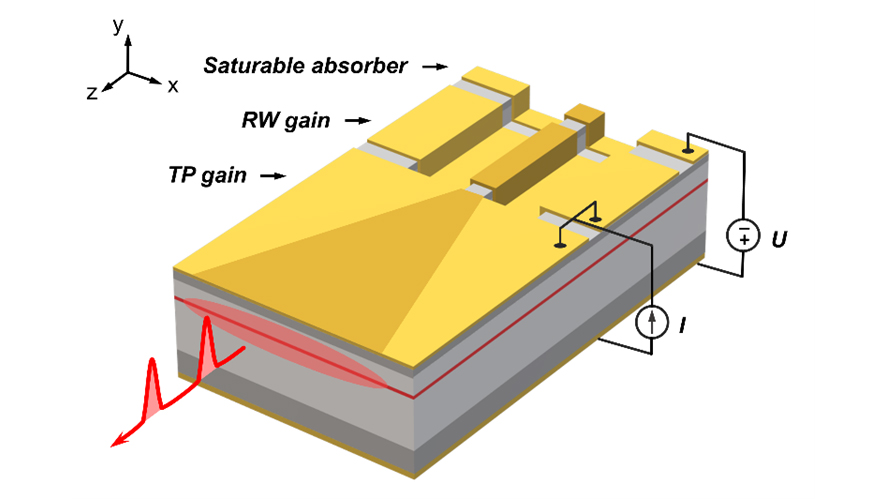
Fig. 1: Schematic of the TP laser [1].
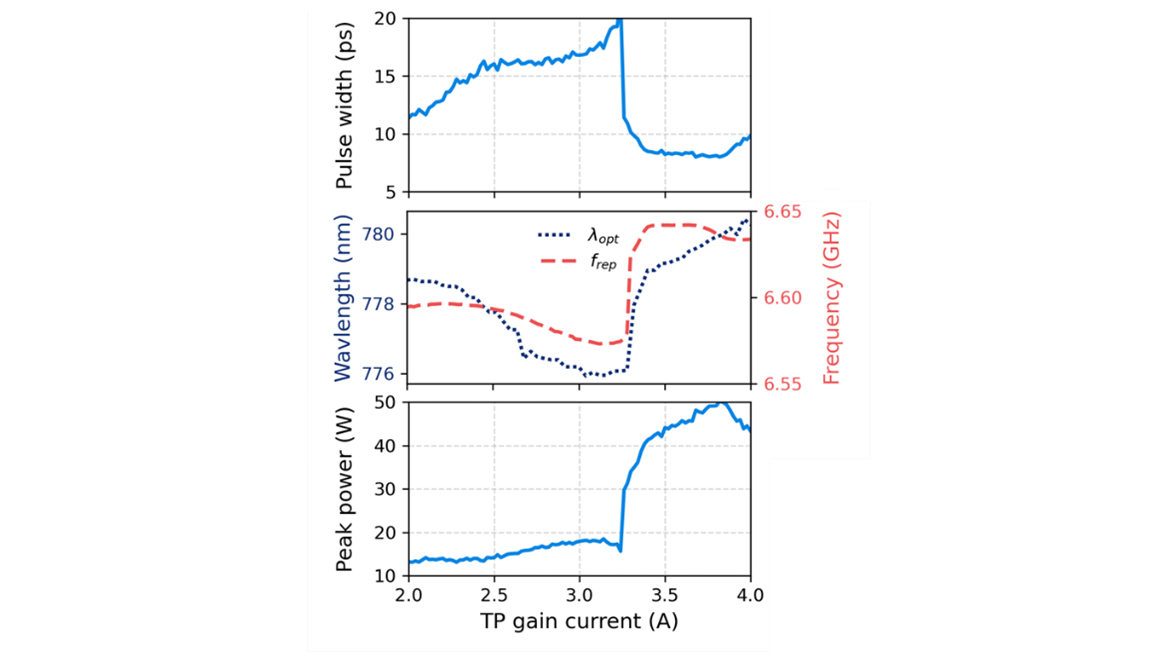
Fig. 2: Mode-locking characteristics of the TP laser: (top) pulse width, (middle) peak wavelength and pulse repetition rate, and (bottom) peak power.
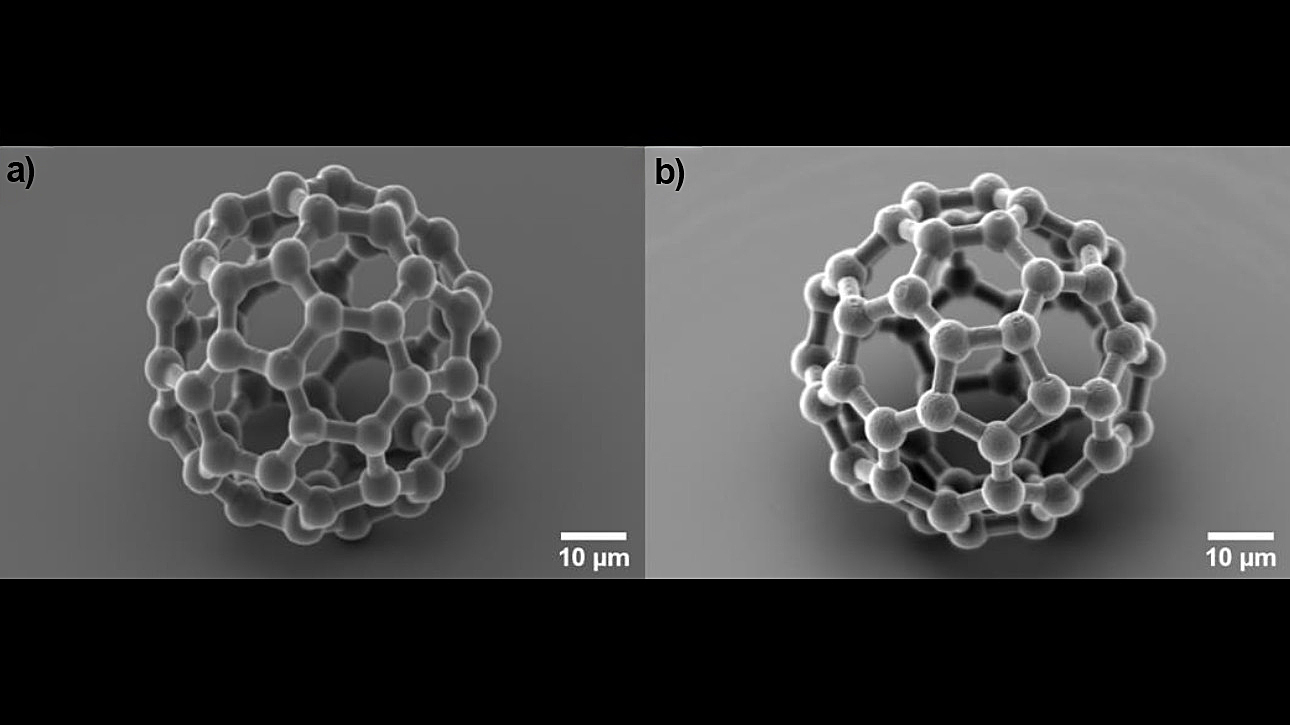
Fig. 3: SEM picture of a fullerene ball produced with an ultrashort-pulse a) diode laser and b) Ti:sapphire laser [2,3].
Typically, ultrashort-pulse high-power Ti:sapphire lasers or fiber lasers are employed as light sources in various applications, such as nondestructive testing with terahertz time-domain spectroscopy (THz-TDS) or sub-micrometer precision 3D printing with two-photon polymerization (2PP). However, these lasers contribute significantly to the setup’s costs. Mode-locked diode lasers offer not only a cost-effective alternative, but their compact size also allows for downsizing of the system, in particular when using monolithic diode lasers. For implementation in, e.g., a high-processing-speed 2PP system, achieving the required optical power in sub-10 ps pulses at multi-GHz repetition rates with a peak wavelength at 780 nm is a challenge. One way to overcome this is to realize a diode laser chip in which the saturable absorber is placed at the rear facet and the gain section is strongly tapered towards the front or output facet.
We have developed a 6 mm long monolithic multi-section diode laser with a GaAsP single quantum well sandwiched in a vertical AlGaAs asymmetric large optical cavity for TM-polarized emission at 780 nm. A 200 µm long ridge-waveguide (RW) section at the rear facet is reverse biased to provide a saturable absorber for mode-locking. The remaining chip length is used as a gain section and subdivided into a 2 mm long RW section for spatial mode filtering and a 3.8 mm long tapered (TP) section for power boosting at the front facet. The RW is 5 µm wide and the TP features a full taper angle of 4°. A schematic of the laser chip is shown in Fig. 1. The laser provides up to 50 W peak power in pulses as short as 8 ps at a repetition rate of about 6.6 GHz and a wavelength of 780 nm (see Fig. 2).
This laser was used to produce, e.g., micro-fullerene balls, as shown in the scanning electron microscope (SEM) picture in Fig. 3. This ball showcases highly detailed 3D structures and the high production quality that can be achieved with our mode-locked TP laser. With results largely comparable to typical Ti:Sa-based 2PP systems, our diode laser outperforms established systems not only in terms of size and weight but also yields improved surface quality in first experiments.
This work is part of the VIP+ program funded by the BMFTR in the MINI2PP project under grant numbers 03VP09211/03VP09212.
Publications
[1] S. Wohlfeil, H. Christopher, J. Fricke, P. Della Casa, A. Maaßdorf, H. Wenzel, A. Knigge, G. Tränkle, „Generation of Picosecond Pulses from Tapered Laser Diodes with over 40 W Peak Power at Wavelengths of 780 nm and 830 nm”, Conference on Lasers and Electro-Optics Europe & European Quantum Electronics Conference (CLEO/Europe-EQEC) 2023.
[2] F. Behlau, N. Surkamp, M. R. Hofmann, C. Esen, A. Ostendorf, S. Wohlfeil, A. Knigge, „Fortschritte bei der Prozessgeschwindigkeit von diodenlaserbasierter Zwei-Photonen-Polymerization,“ MikroSystemTechnik Kongress 2025.
[3] S. Wohlfeil, J.-P. Koester, H. Wenzel, A. Knigge, “Spatio-temporal modelling and simulation of a mode-locked tapered semiconductor laser,” New Journal of Physics 27, art. 013011 (2025).