Fundamental Physics
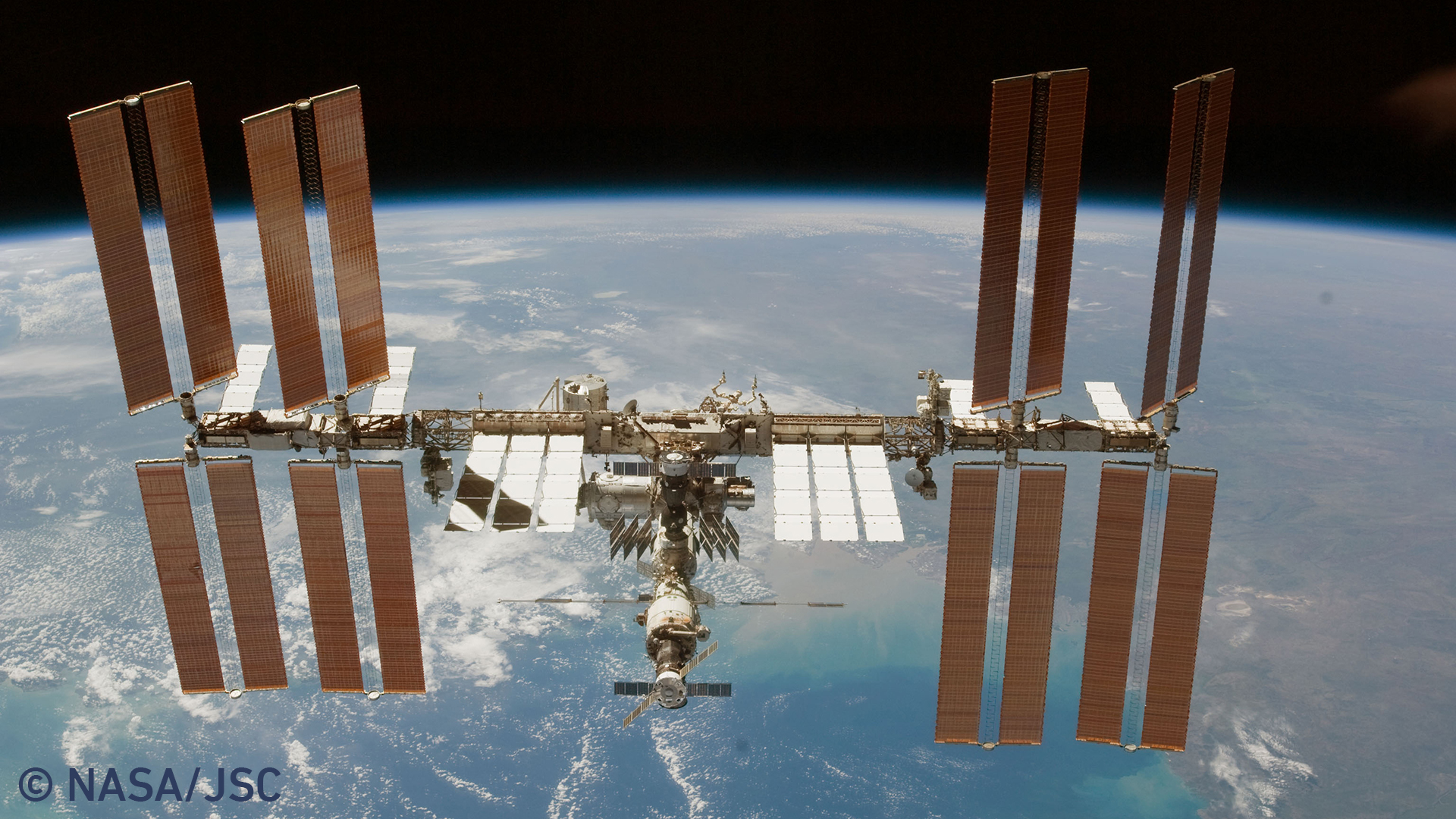
The Bose-Einstein-Condensate and Cold Atom Laboratory (BECCAL) is a multi-user facility on board the International Space Station (ISS) that aims at conduction experiments with ultracold and condensed atoms in a micro-gravity environment. Co-founded by the German Aerospace Agency (DLR) and NASA, the main goals of BECCAL is to enable fundamental research and advance technology development for future quantum-based sensors.
© FBH / schurian.com
The BECCAL apparatus is realized by the Institute for Satellite Geodesy and Inertial Sensing and the Institute of Quantum Technologies with support by DLR Space Administration. Ferdinand-Braun-Institut, Humboldt-Universität zu Berlin, Johannes-Gutenberg Universität Mainz, Leibniz Universität Hannover, Universität Bremen, Universität Ulm, and OHB System AG share different aspects of the project work.
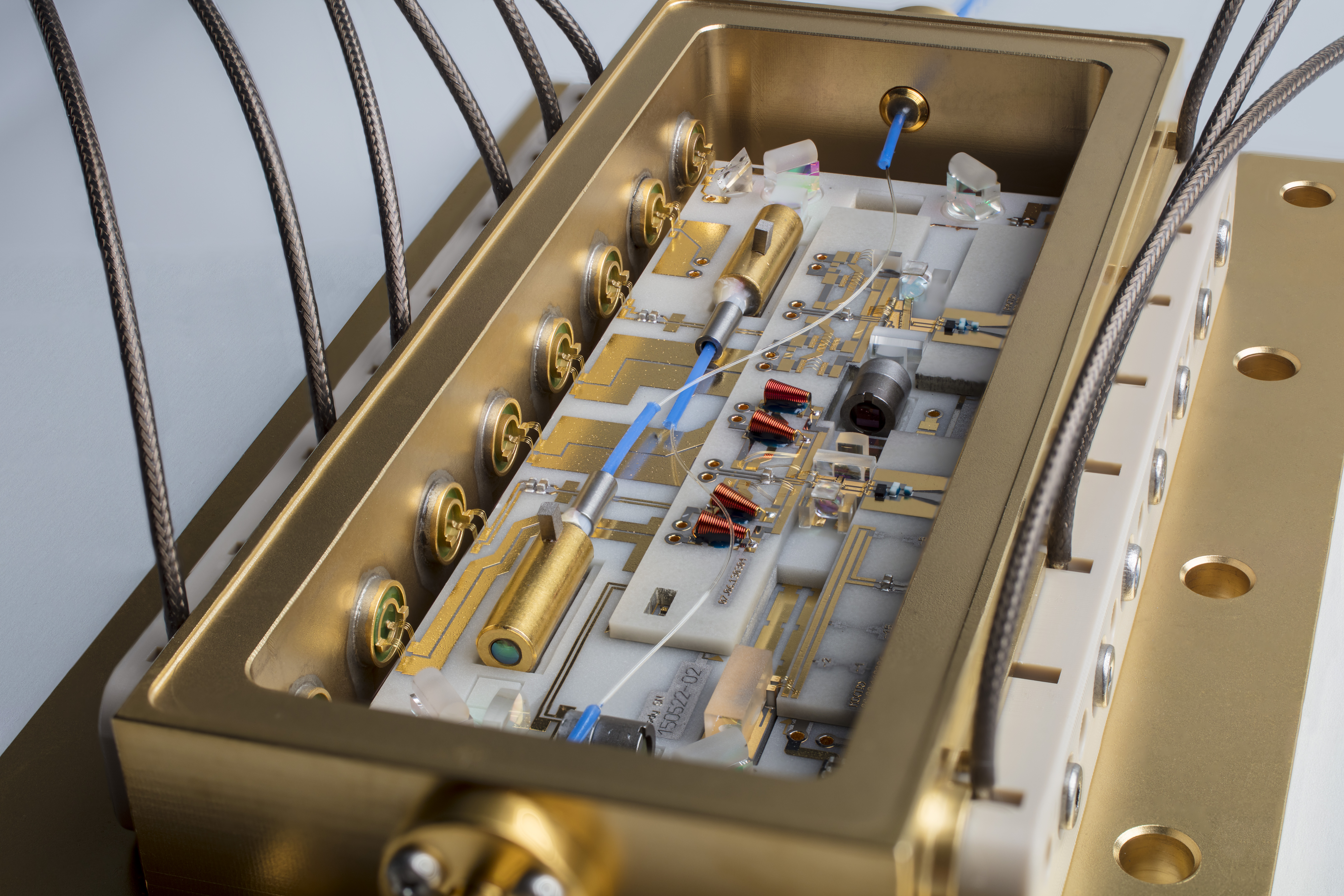
The laser system for BECCAL is designed and integrated by the Humboldt-Universität zu Berlin. The Ferdinand-Braun-Institut and the Johannes-Gutenberg Universität Mainz contribute the laser modules and the distribution modules, respectively.
The laser system consists of a total of 16 ECDL-MOPA in MiLas-technology, delivering between 250 mW and 500 mW of narrow linewidth emission at wavelengths of 764 nm, 767 nm, 780 nm and 1064 nm for laser cooling, atom trapping, manipulation, and detection in experiments with rubidium and potassium Bose-Einstein condensates.
This work is supported by the German Space Agency DLR with funds provided by the Federal Ministry of Economics and Energy (BMWi) under grant numbers 50WP1704 and 50WP2104.
[1] Frye et al., "The Bose-Einstein Condensate and Cold Atom Laboratory," EPJ Quantum Technology (2021) 8:1, https://doi.org/10.1140/epjqt/s40507-020-00090-8