Quantum electrometer for time-resolved material science at the atomic lattice scale
Researchers at Humboldt-Universität zu Berlin and Ferdinand-Braun-Institut have developed a quantum electrometer capable of resolving electric fields created by individual charges with exceptional spatial (down to 1 Å) and temporal (60 ns steps) resolution.
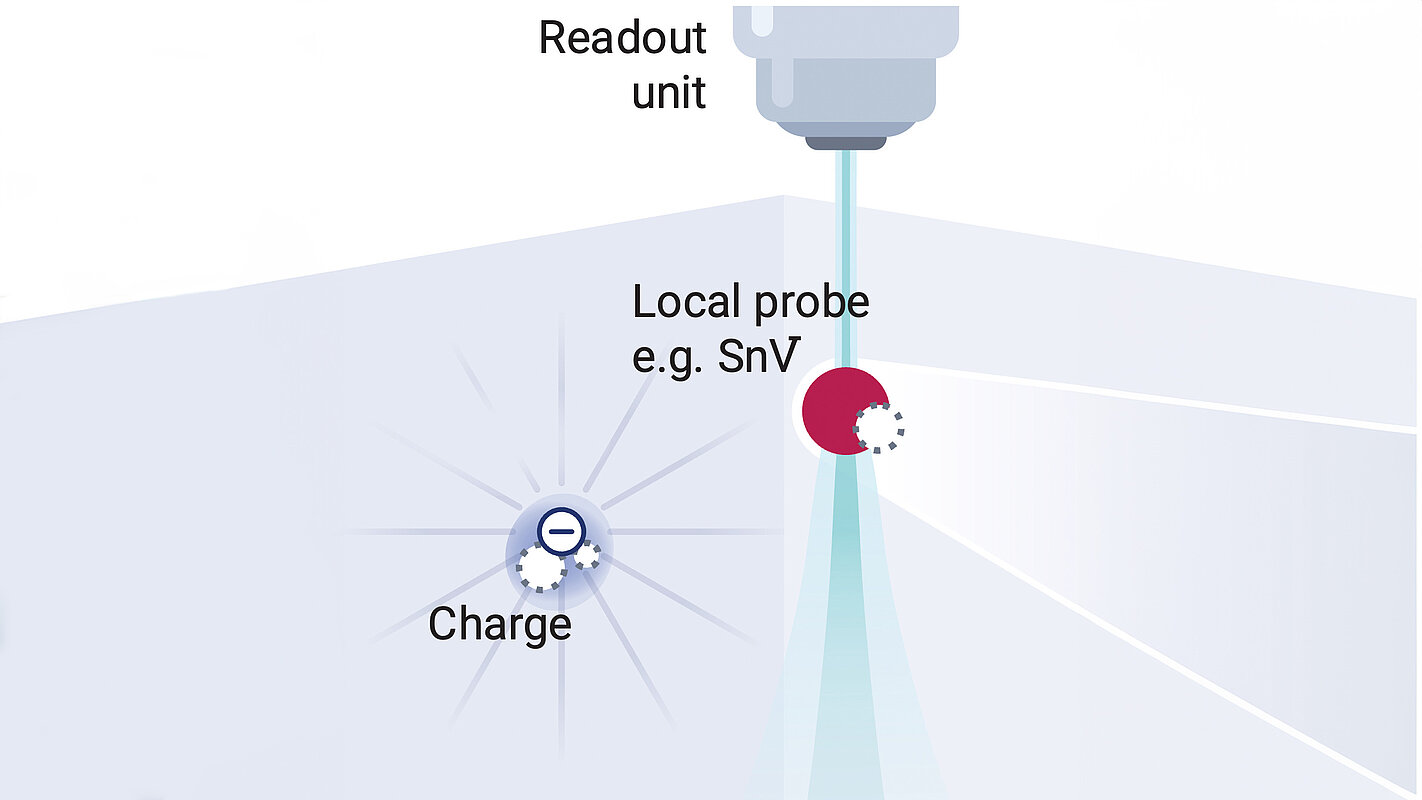
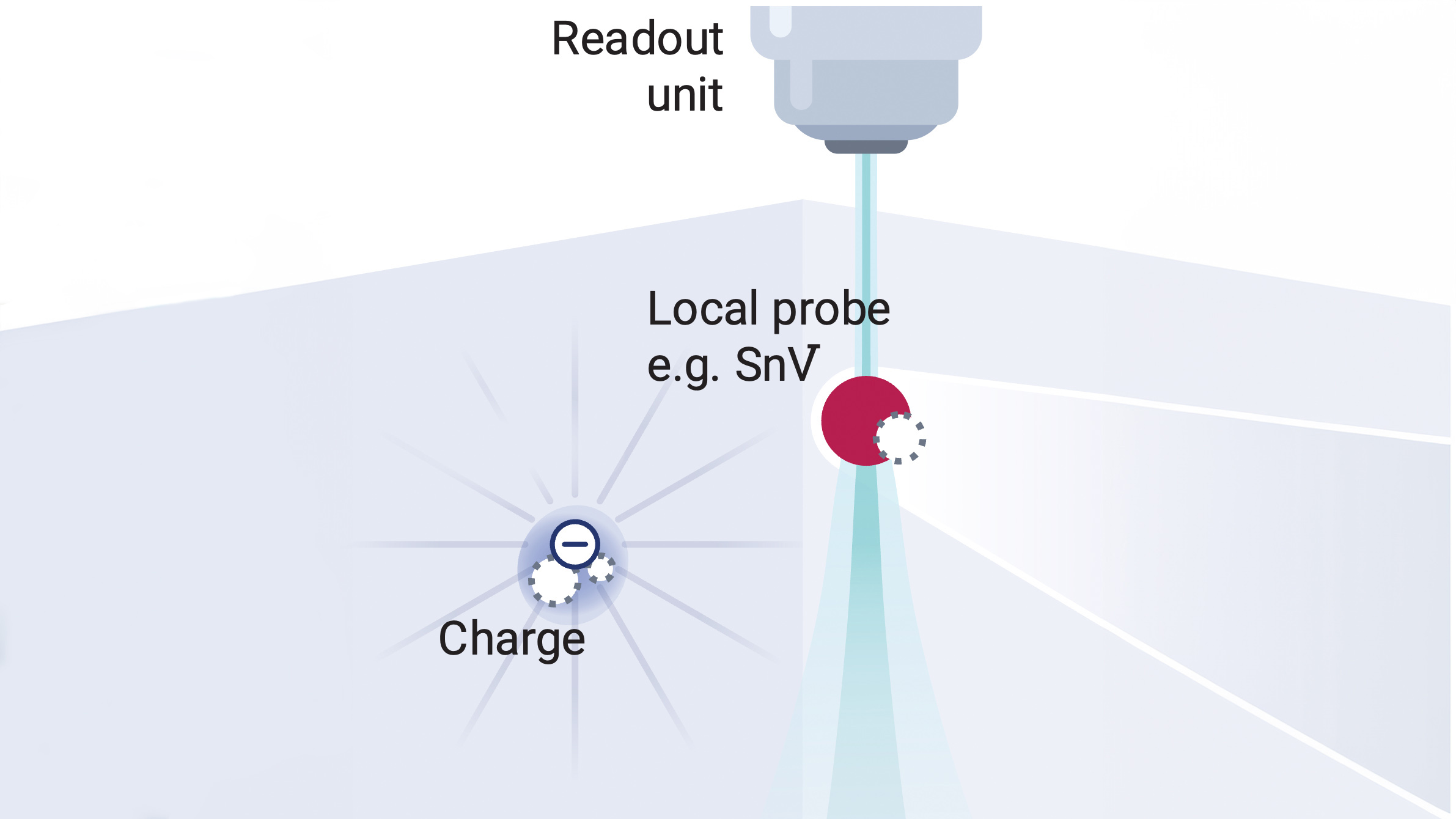
This electrometer uses a negatively-charged tin-vacancy (SnV) defect in diamond as a sensor, exploiting its sensitivity to electric fields through spectroscopy of its optical transition. Fig. 1 illustrates how the spectrum of the SnV sensor is modified by the Stark effect generated by a single charge trapped in a nearby defect. The preparation of the diamond sample hosting the sensor is led by FBH, including in-house implantation of the color centers, and nanostructure fabrication for enhanced signal acquisition and further functionalization for quantum technological applications.
Thanks to its exceptionally high spatial (see Fig. 2) and temporal resolution, the electrometer can identify and quantify charge traps at the atomic scale, contributing significantly to fundamental materials science and quantum technology. Furthermore, trapping of charges constitutes a change in a defect’s charge state, modifying its electronic structure. These processes occur by exchanging electrons with the bands of the solid-state material following a characteristic rate (see Fig. 3). For the first time, it was possible to analyze the ionization and re-initialization times of different charge trap species in diamond under different illumination wavelengths. These insights have enabled fabrication recipes for low noise, artificially created, optically-active spin defects.
Further potential practical applications include the precise characterization of semiconductor devices, optimization of materials for quantum computing and sensing, and a deeper understanding of decoherence in quantum systems.
This research was supported by ERC (QUREP, No. 851810), BMBF (DiNOQuant, QPIS, QPIC-1), Einstein Foundation Berlin, and the Alexander von Humboldt Foundation. A patent application has been submitted.
Publication
G. Pieplow, C. G. Torun, J. H. D. Munns, F. M. Herrmann, A. Thies, T. Pregnolato, and T. Schröder, "Quantum Electrometer for Time-Resolved Material Science at the Atomic Lattice Scale" (2024), arXiv:2401.14290.