SUPER excitation protocol enables ultrafast, non-resonant, spin-conserving optical control of tin-vacancy centers in diamond
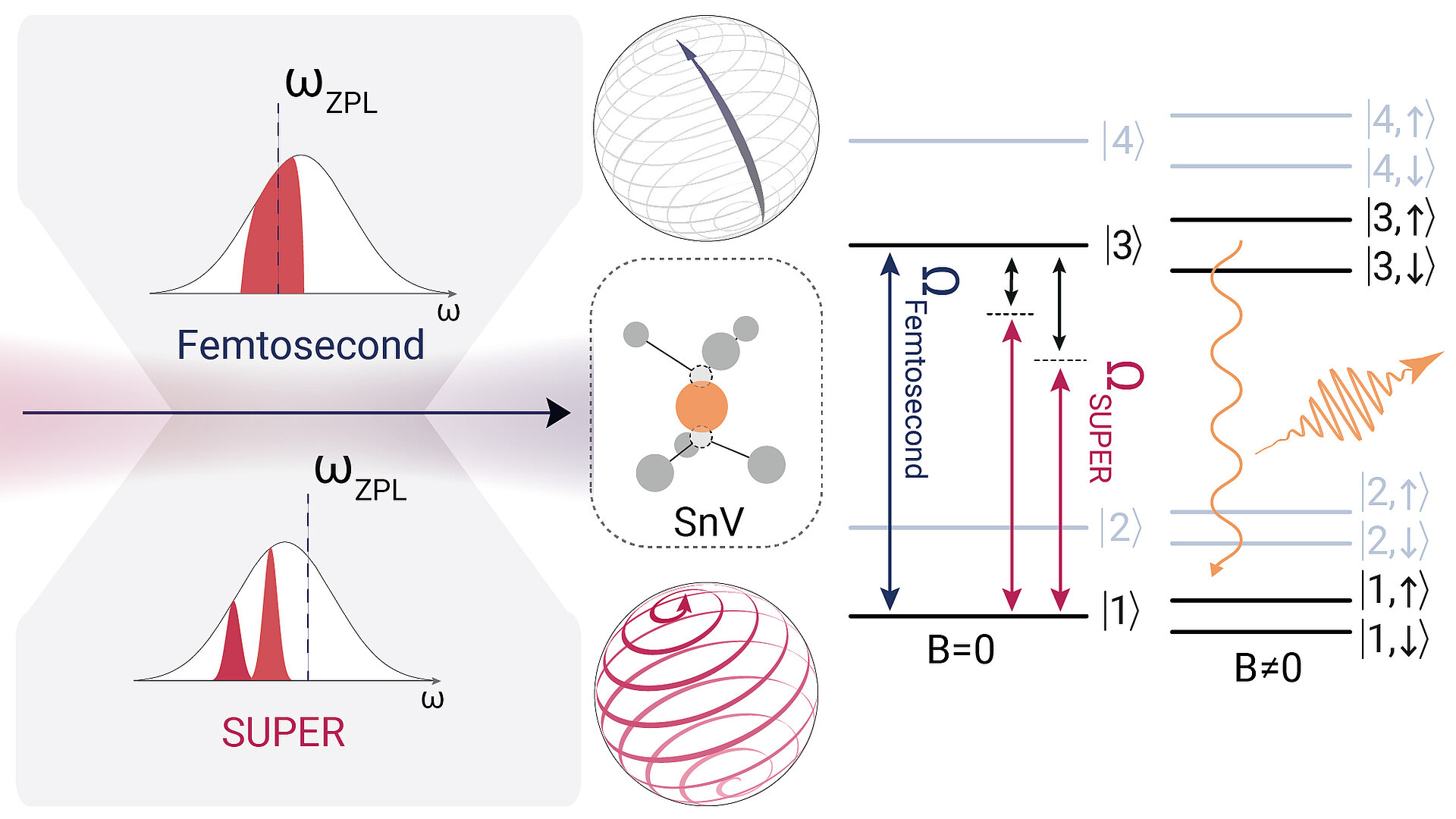
Fig. 1: Femtosecond and SUPER excitation of a SnV center in diamond. Femtosecond excitation is resonant and enables record-fast optical control, while SUPER excitation is non-resonant, relies on more complex population dynamics, and allows spectral filtering of the excitation light.
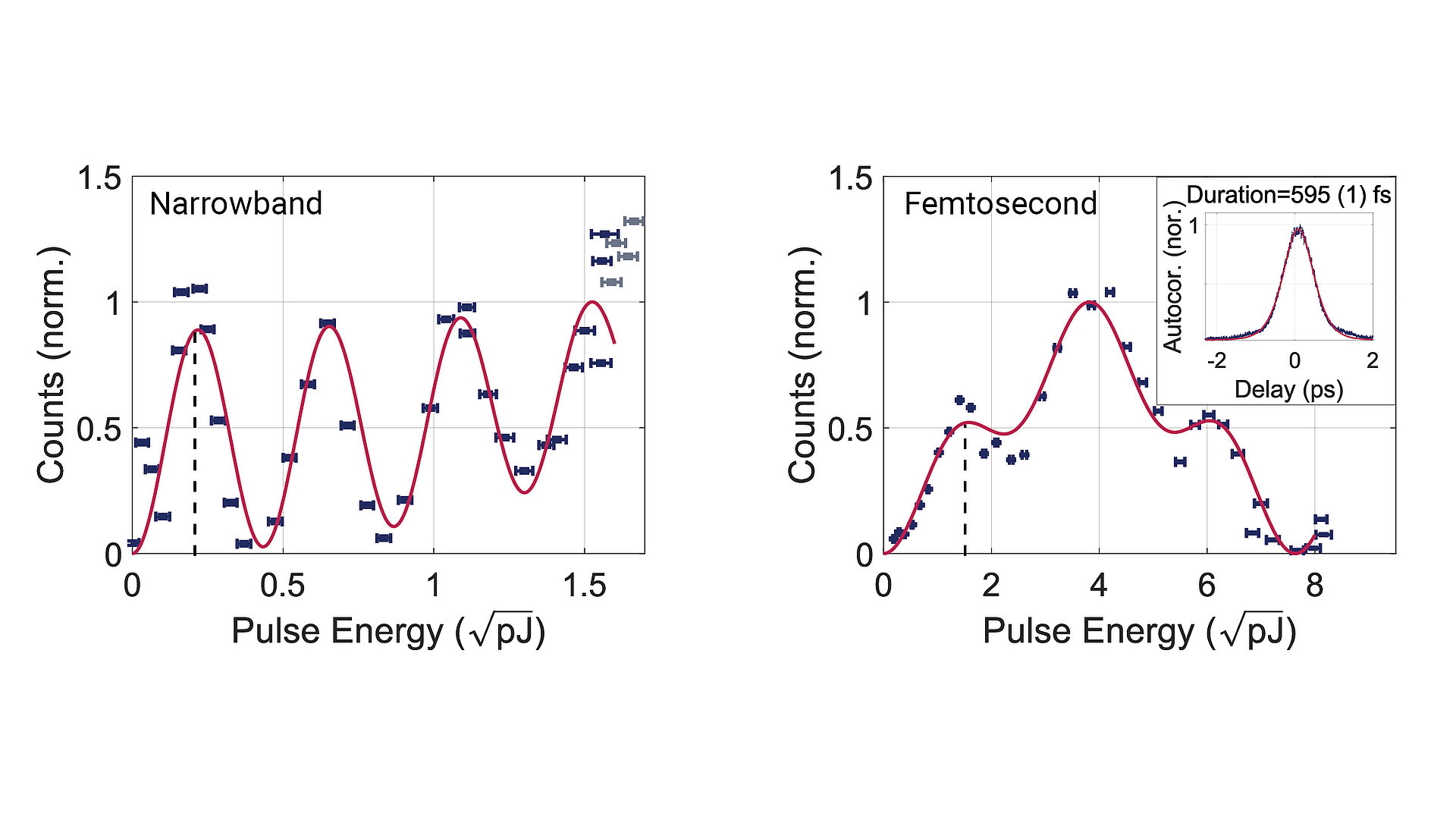
Fig. 2: Resonant optical Rabi rotations of the SnV center, extracted by varying the pulse power and integrating the total number of registered photons, using a narrowband pulse (l.) and a broadband quadrilateral pulse (r.). The dashed lines indicate the pulse energies corresponding to a π-rotation.
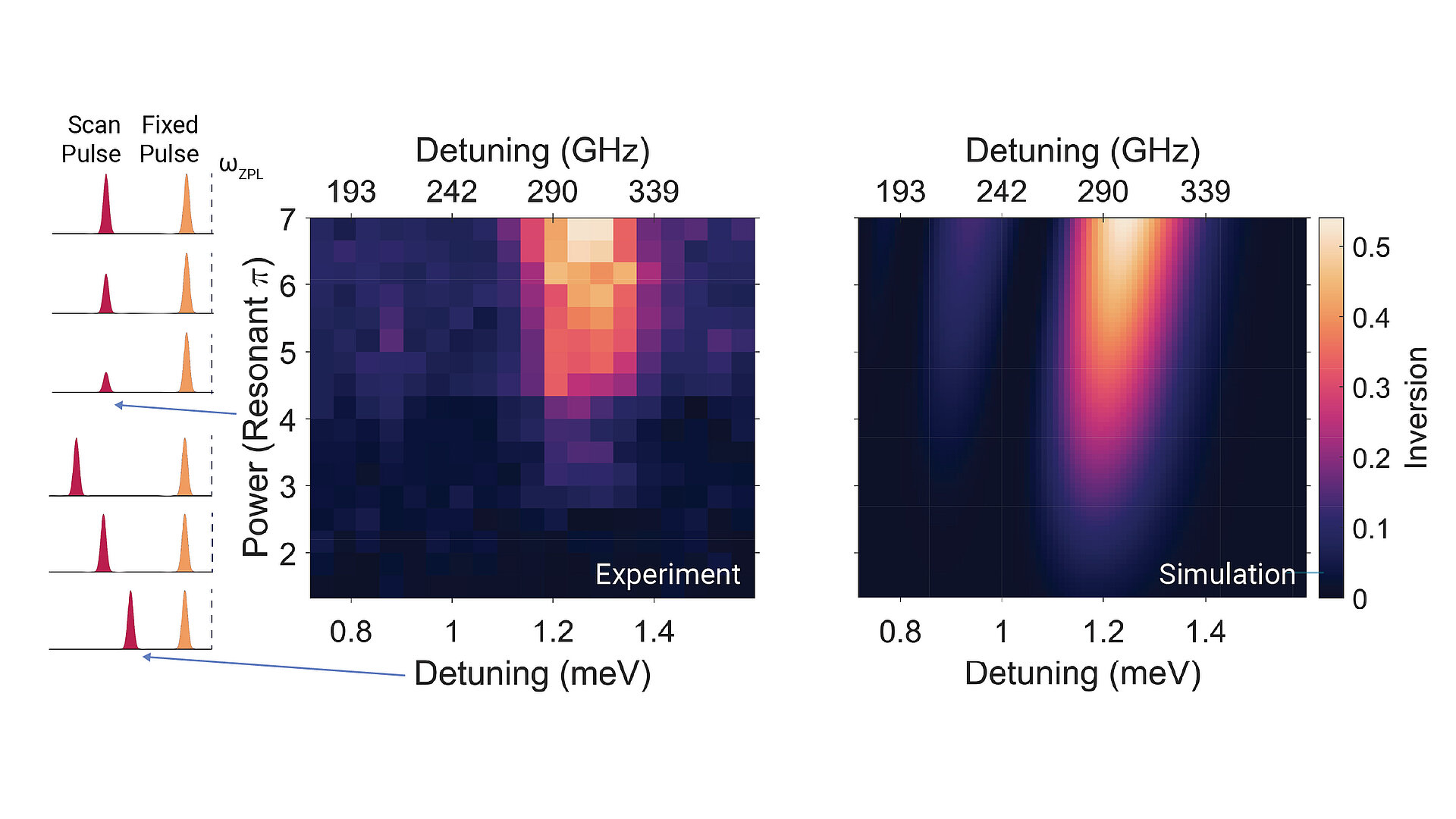
Fig. 3: Experimental map and theoretical simulation of the SUPER excitation scheme for a SnV center in diamond.
Secure quantum communication and future quantum networks depend on reliable sources of single photons. A team from Ferdinand-Braun-Institut (FBH) and Humboldt-Universität zu Berlin now shows how ultrafast laser control and a novel excitation scheme can improve the generation of such photons in diamond. We demonstrate coherent optical control of a tin-vacancy (SnV) color center in diamond using the SUPER protocol (Swing-UP of the quantum EmitteR population) combined with ultrafast resonant excitation (Fig. 1). This work establishes a route toward efficient spin-photon interfaces in diamond by combining non-resonant coherent excitation with femtosecond optical control. A key advantage of the SUPER approach is its ability to enable spectral separation of the excitation light from the emitted photons, thereby addressing a central limitation of conventional resonant excitation schemes. Both schemes support the ultrafast generation of single photons, further strengthening their potential for quantum technologies.
The experiments were performed on SnV centers embedded in diamond nanopillars fabricated at FBH. Using a pulse-carving platform, we generated narrowband picosecond pulses, broadband femtosecond pulses, and two-color detuned pulses for SUPER excitation. Under resonant ultrashort excitation, we observed optical Rabi oscillations with both picosecond and femtosecond pulses, enabling sub-picosecond control and GHz-rate coherent operations (Fig. 2). This demonstrates coherent population control in both regimes, while the femtosecond excitation extends the control to record-fast timescales for diamond color centers.
For the SUPER scheme, two red-detuned pulses were used to achieve non-resonant coherent excitation, with experimentally demonstrated population inversion of up to 55 %, in very good agreement with theoretical modeling performed at Technical University Dortmund (Fig. 3). Simulations further indicate that near-unity inversion should be achievable at higher pulse powers. The study also addresses the spin degree of freedom relevant for quantum networking. Theoretical analysis shows that the SUPER protocol can preserve spin superpositions during excitation, while dedicated measurements revealed no observable additional spin mixing. The good agreement between experiment and simulation confirms the expected non-resonant population transfer dynamics.
Overall, the results identify SUPER excitation as a promising control scheme for solid-state quantum emitters and extend optical control of diamond color centers to an ultrafast timescale. This provides an important basis for deterministic photon generation, multi-gate optical control, and future spin-photon or spin-spin entanglement protocols in diamond-based quantum network nodes.
This work was financially supported by the European Research Council (ERC, Starting Grant QUREP, No. 851810), the German Federal Ministry of Research, Technology and Space (QPIS, No. 16KISQ032K; QPIC-1, No. 13N15858; QR.X, No. KIS6QK4001), and by the Turkish Ministry of National Education (YLSY Scholarship Program).
Publication
Torun, C. G. et al., “SUPER and femtosecond spin-conserving coherent excitation of a tin-vacancy color center in diamond”, Nature Communications 17, 2154 (2026).