Fast polymer identification with a compact quantum-optical module
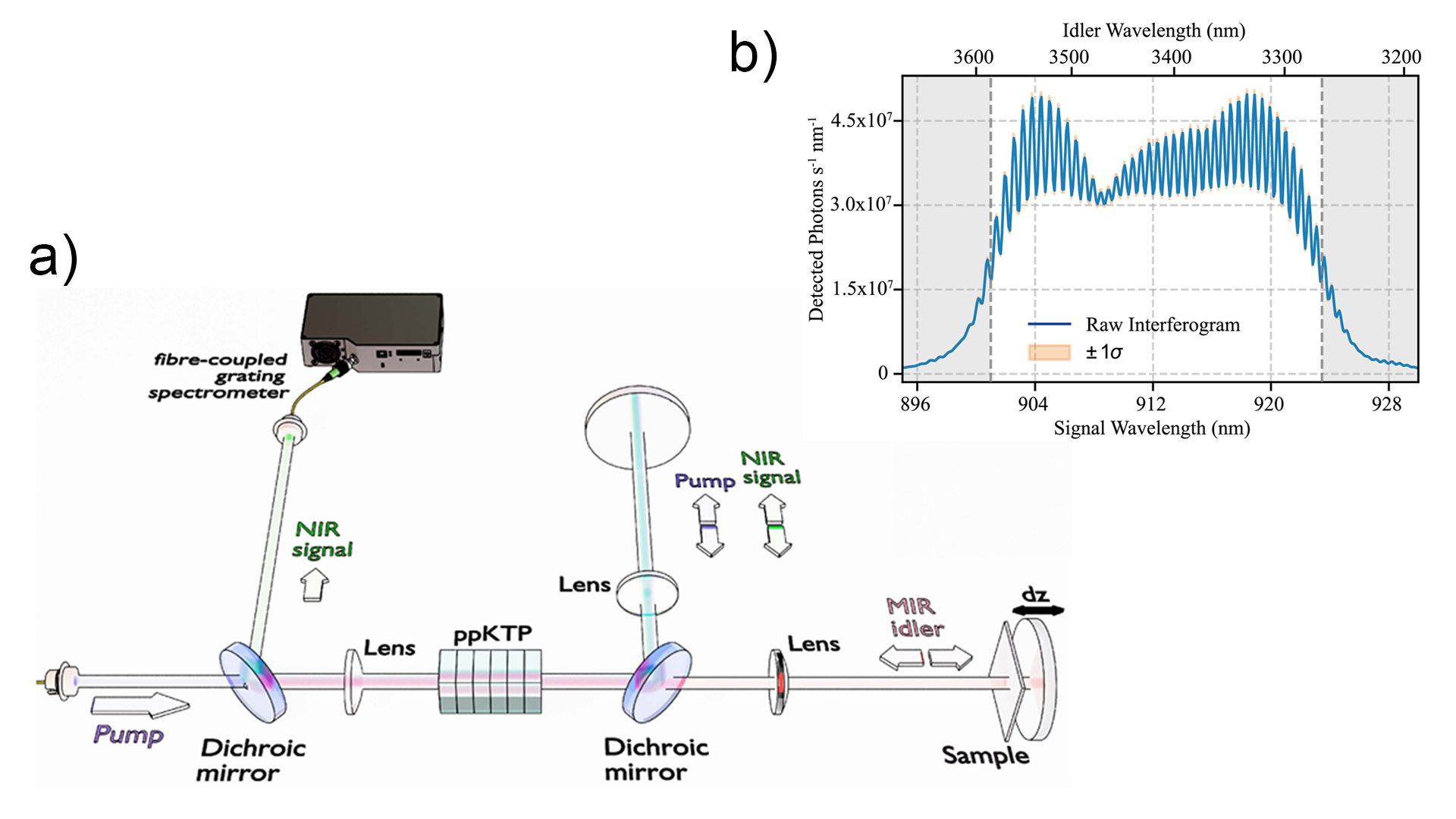
Fig. 1: Working principle and typical quantum interference spectra.
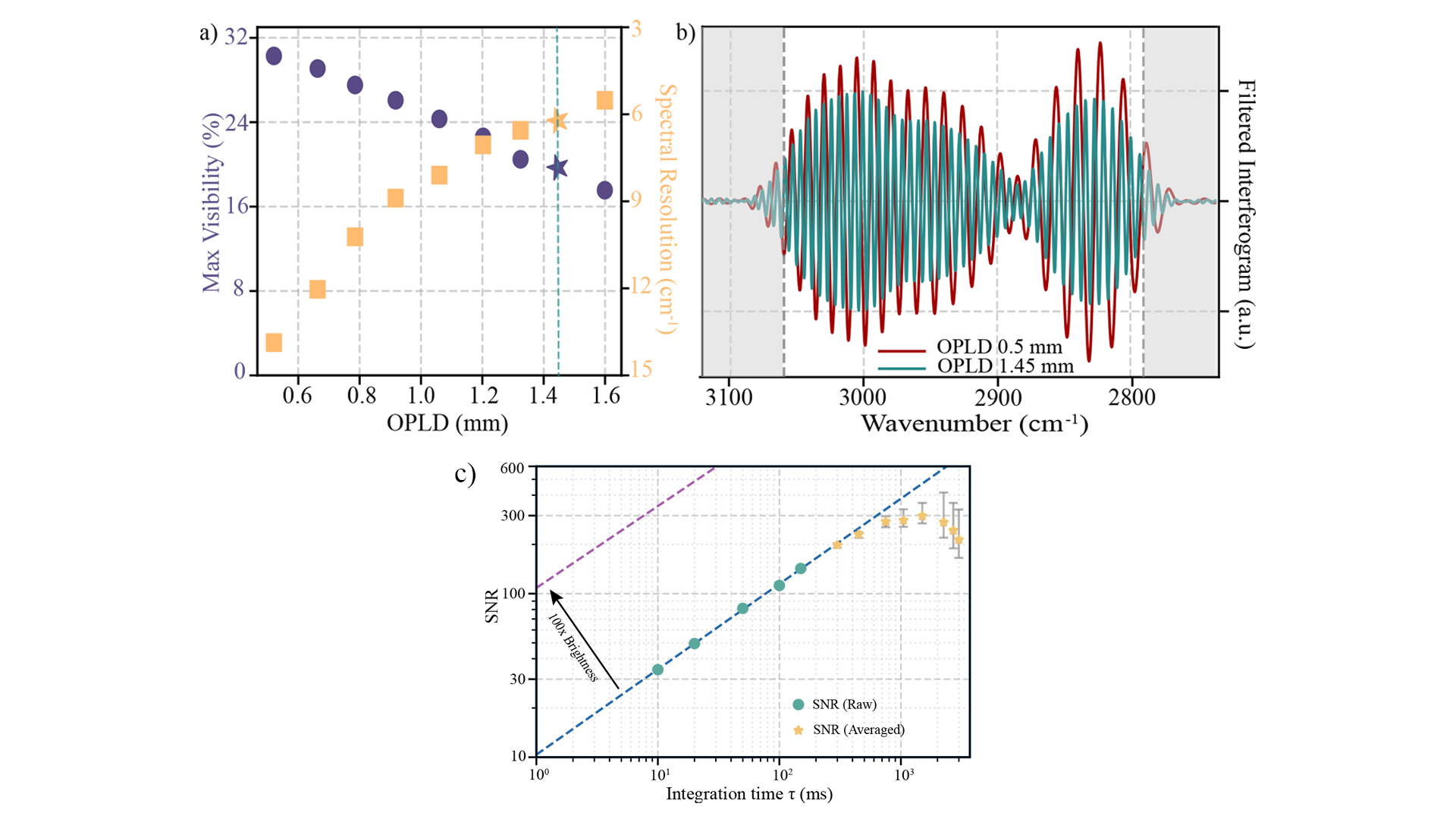
Fig. 2: (a) Detailed characterization results on interference visibility and spectral resolution vs. OPLD; (b) the filtered interferograms at short (0.5 mm, red) and selected (1.45 mm, dark cyan) OPLD; (c) the SNR scaling with integration time.
Plastic pollution has become a critical global challenge, with microplastics pervading ecosystems and entering human food chains. Monitoring this contamination calls for fast, reliable and portable methods of identifying plastics. Researchers from Ferdinand-Braun-Institut (FBH) and Humboldt-Universität (HU) have developed a system with a compact photonic module that identifies plastics within a fraction of a second – without requiring a mid-infrared detector. Based on undetected-photon spectroscopy, the system can distinguish polypropylene, polyethylene and polystyrene as fast as 100 times per second.
Mid-infrared (MIR) light is well-suited for identifying polymers, since molecular bond vibrations show up in this spectral range. However, mid-infrared detectors are expensive, noisy or require cryogenic cooling, which is why lab-grade instruments such as Fourier-transform infrared (FTIR) spectrometers are slow and impractical. To overcome this limitation, the team's module uses quantum sensing: a standard, low-cost silicon-based spectrometer is enough to reconstruct the full mid-infrared absorption spectrum. The working principle (Fig. 1a) uses a pump laser generating correlated near-infrared (NIR) signal (green) and MIR idler (red) photons via SPDC in a periodically poled potassium titanyl phosphate (ppKTP) crystal. A dichroic mirror sends the idler to the sample while pump and signal take a separate path that has a well-defined optical pathlength difference (OPLD); all fields are then reflected back through the crystal. Absorption in the idler is thereby mapped onto an interference pattern in the signal, read out by a fiber-coupled spectrometer. Fig. 1b shows a resulting, typical spontaneous parametric down-conversion (SPDC) interferogram at 10 ms integration time with the 22 nm (270 cm⁻¹) bandwidth covering the CH-stretch-region used for polymer analysis.
At FBH, the entire quantum light interferometer was integrated into a self-contained, temperature-stabilized module measuring just 95 × 75 × 30 mm³, with no moving parts. In tests, it reached a signal-to-noise ratio of 34 within 10 milliseconds while resolving spectral features down to about 6 cm⁻¹. The signal-to-noise ratio (SNR) follows a theoretically expected shot-noise √τ scaling up to ~0.5 s before drift-induced saturation sets in at SNRs of 300. The extrapolated scaling for a 100× brighter source predicts SNRs of ~100 even at 1 kHz measurement rates (Fig. 2).
Importantly, this performance is comparable to much larger laboratory implementations of the measurement principle and is sufficient to clearly identify the CH-stretch vibrations of polypropylene, polyethylene and polystyrene films, matching spectra from a commercial FTIR instrument. This combination of speed, robustness and small footprint suits applications that are difficult to address with conventional mid-infrared spectrometers. These include continuous, field-deployable monitoring such as detecting microplastics in water, quality control in plastics recycling, or tracking gases. With additional x-y-scanning, the approach can also extend to hyperspectral mid-infrared imaging, for example for medical diagnostics.
Next steps include boosting brightness via advanced nonlinear crystal designs, improving the diode-laser pump source. Fully integrating fiber coupling and MIR-focusing could help develop the demonstrator into a low-cost, portable sensing platform.
Publication
A. U. R. Sherwani, E. Pearce, P. Hildenstein, F. Mauerhoff, A. Sahm, K. Paschke, H. M. Chrzanowski, S. Ramelow, “Polymer identification via undetected photons using a low footprint nonlinear interferometer,” Optics Express 34 (11), 2026.